
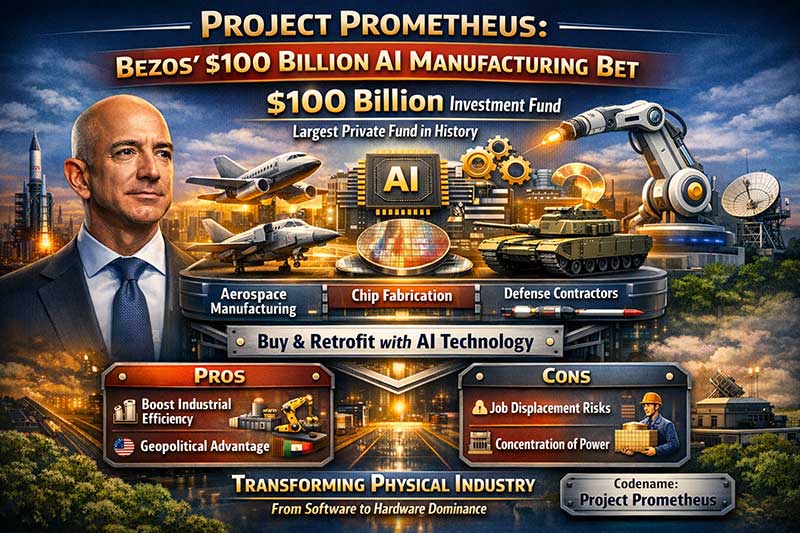
The move by Bezos to raise a staggering $100 billion fund, which has been rumoured to be under the codename “Project Prometheus,” may be a potential turning point in the evolution of artificial intelligence from a mere digital tool to a powerful driver of change in the physical world. The strategic intent behind this move is quite simple, but the impact is likely to be revolutionary in nature. The basic premise is to buy existing industrial capacity and retrofit it with AI to create new levels of efficiency, scale, and geopolitical influence.
At a deeper level, this move by Bezos is a part of a new narrative in the evolution of artificial intelligence. The last decade has been dominated by software platforms, cloud computing, and data services in terms of value creation. However, this is now set to change with economists like Erik Brynjolfsson, a professor at Stanford University, stating, “the full productivity benefits of general-purpose technologies like AI are realized only when they are deeply embedded into physical and organizational processes” (Brynjolfsson et al., The Second Machine Age, 2014). Bezos is now taking this narrative to a new level with his move to raise a fund to buy industrial capacity in sectors like chipmaking, which is already a key driver in geopolitical competition, and aerospace and defence.
The potential advantages of such a fund are immense. Firstly, the productivity growth that could be achieved by AI-based manufacturing could be similar to, if not greater than, the productivity growth that resulted from past industrial revolutions. According to a report by McKinsey & Company, AI-based automation of manufacturing could create up to $3.7 trillion of value annually by 2030. This could mean that companies like Tesla could use AI to automate their manufacturing processes, while companies like Boeing could use AI to enhance their predictive maintenance of their products.
Secondly, there is a geopolitical dimension to this initiative. Semiconductor fabrication plants and defence manufacturing are increasingly synonymous with power. The recent chip shortage that resulted from the COVID-19 pandemic highlighted the weakness of global supply chains. This has resulted in initiatives such as the US CHIPS Act and the Indian semiconductor mission. An AI-based manufacturing initiative could be the solution to this. As Narendra Modi emphasized, “Self-reliance in critical technologies is essential for national security and economic growth”(Government of India policy statements, 2021-2023).
The initiative, however, comes with significant risks and criticisms. Firstly, there are risks of undue power concentrated in the hands of private players. Such an initiative could potentially result in the marginalization of players who are not part of this initiative. This could result in monopolies. As Mariana Mazzucato argued, such an initiative could be a recipe for “privatizing gains while socializing risks” (The Entrepreneurial State, 2013). If such an initiative results in the loss of jobs due to AI-based efficiency, it could result in significant social backlash, especially if such an industry is a significant pillar of the economy.
Another issue that may be challenging is the complexity of retrofitting existing manufacturing systems with AI. This could be expensive, and results may not be felt as quickly as expected. Industry experience with Industry 4.0 initiatives indicates that while there are efficiency promises associated with such initiatives, there are implementation bottlenecks to be overcome. This may be related to workforce skills, interoperability, and data governance, as highlighted by the World Economic Forum (2020).
From an Indian point of view, this issue may have both positive and negative implications. The Indian government’s desire to become a global manufacturing hub under initiatives such as “Make in India” may be positively impacted by spillovers from such investments. On the other hand, there may be a danger of capital flows to emerging markets being dominated by a select group of countries, forcing such countries to become dependent on external ecosystems.
In conclusion, Bezos’s reported investment of a billion dollars into Project Prometheus may be a bold wager on the convergence of AI and capital. This may be premised on Peter Drucker’s assertion that “the greatest change will be in manufacturing, where knowledge will become the key resource” (Post-Capitalist Society, 1993). This initiative may either be a landmark achievement or an overambitious experiment.
Dr. Prahlada N.B
MBBS (JJMMC), MS (PGIMER, Chandigarh).
MBA in Healthcare & Hospital Management (BITS, Pilani),
Postgraduate Certificate in Technology Leadership and Innovation (MIT, USA)
Executive Programme in Strategic Management (IIM, Lucknow)
Senior Management Programme in Healthcare Management (IIM, Kozhikode)
Advanced Certificate in AI for Digital Health and Imaging Program (IISc, Bengaluru).
Senior Professor and former Head,
Department of ENT-Head & Neck Surgery, Skull Base Surgery, Cochlear Implant Surgery.
Basaveshwara Medical College & Hospital, Chitradurga, Karnataka, India.
My Vision: I don’t want to be a genius. I want to be a person with a bundle of experience.
My Mission: Help others achieve their life’s objectives in my presence or absence!
My Values: Creating value for others.
Leave a reply



























Leave a reply