
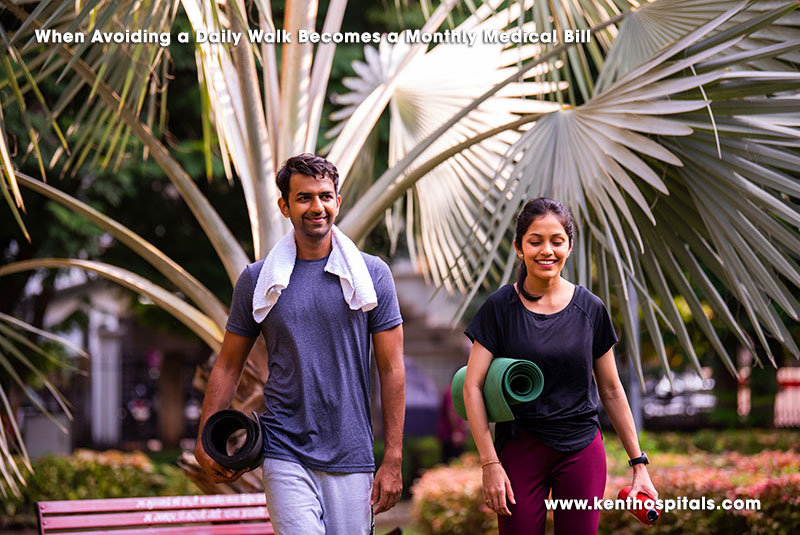
A striking warning from a Delhi-based cardiologist has ignited an uncomfortable but necessary conversation: many urban Indians may end up spending nearly ₹29,000 a month by not walking—essentially the price they later pay to a cardiologist to repair the damage caused by that very inactivity. The statement sounds provocative, even harsh, but it reflects a daily reality seen inside clinics, cath labs, and intensive care units across the country.
Modern city life has quietly engineered movement out of our routines. Ride-hailing apps, personal vehicles, fuel costs, tolls, and parking charges together create a lifestyle where walking is no longer necessary. Elevators replace stairs, food arrives at the desk, and screens dominate waking hours. None of these expenses seem alarming in isolation, but together they buy a sedentary existence. The irony, as the cardiologist points out, is painful: we pay handsomely to avoid physical effort, and later pay exponentially more to manage hypertension, diabetes, coronary artery disease, and stroke.
Indian wisdom has long warned against this disconnect between comfort and health. Mahatma Gandhi famously said, “It is health that is real wealth, not pieces of gold and silver.” Yet urban professionals often reverse this equation—spending gold to purchase convenience, then sacrificing health in the process. Internationally, Hippocrates echoed the same truth centuries ago: “Walking is man’s best medicine.” Despite advances in medical technology, this fundamental principle has not changed.
The cardiologist’s critique extends beyond transport to the booming wellness industry. Meditation apps, premium subscriptions, and digital mindfulness tools promise calm and clarity. Many professionals proudly maintain streaks, yet continue to struggle with anxiety, poor sleep, and uncontrolled blood pressure. The missing link, he argues, is movement. Mindfulness without motion is incomplete. A daily walk—unhurried, device-free, rhythmic—can itself become a moving meditation, regulating cortisol, improving insulin sensitivity, and restoring autonomic balance. Neuroscience and cardiology both support this: moderate aerobic activity has well-documented effects on mood, blood pressure, and endothelial health.
From the cath lab, the doctor describes a profile that has become disturbingly common. A 35-year-old startup founder or corporate executive works 16–18 hours a day, sleeps five hours, eats whatever is delivered, and considers the walk from office to car as “exercise.” Youth is assumed to be protective. When chest pain or a heart attack strikes, disbelief follows. Yet arteries, as the doctor bluntly reminds patients, do not recognize job titles or birthdays. They respond only to cumulative habits—physical inactivity, poor sleep, chronic stress, and metabolic overload.
There are, of course, perceived pros to convenience-driven living. It saves time, reduces immediate fatigue, and fits neatly into demanding professional schedules. Digital wellness tools offer accessibility and structure. However, the cons are profound and long-term: rising cardiovascular risk, escalating healthcare costs, reduced productivity, and a shrinking healthspan. What is saved in minutes today is lost in years later.
A simple parable from Indian folklore illustrates this well. A man avoids sharpening his axe because he is too busy chopping wood. Over time, the blunt axe demands more effort and yields less result. Walking, sleep, and basic movement are the sharpening stones of human physiology. Neglect them, and no amount of medical intervention can fully compensate.
From an international perspective, Dr. Kenneth Cooper, pioneer of aerobic exercise, put it succinctly: “We do not stop exercising because we grow old—we grow old because we stop exercising.” The Delhi cardiologist’s warning is not an attack on technology or progress; it is a call for balance. Convenience should serve health, not replace it.
The advisory is clear and evidence-based: reclaim walking as non-negotiable healthcare. Build it into commutes, meetings, and daily rituals. Use technology wisely, but do not outsource movement to machines or mindfulness to apps alone. Otherwise, the monthly bill for comfort will quietly transform into a lifetime invoice for disease—one no one truly wants to pay.
Dr. Prahlada N.B
MBBS (JJMMC), MS (PGIMER, Chandigarh).
MBA in Healthcare & Hospital Management (BITS, Pilani),
Postgraduate Certificate in Technology Leadership and Innovation (MIT, USA)
Executive Programme in Strategic Management (IIM, Lucknow)
Senior Management Programme in Healthcare Management (IIM, Kozhikode)
Advanced Certificate in AI for Digital Health and Imaging Program (IISc, Bengaluru).
Senior Professor and former Head,
Department of ENT-Head & Neck Surgery, Skull Base Surgery, Cochlear Implant Surgery.
Basaveshwara Medical College & Hospital, Chitradurga, Karnataka, India.
My Vision: I don’t want to be a genius. I want to be a person with a bundle of experience.
My Mission: Help others achieve their life’s objectives in my presence or absence!
My Values: Creating value for others.
Reference:
Leave a reply





















Leave a reply