
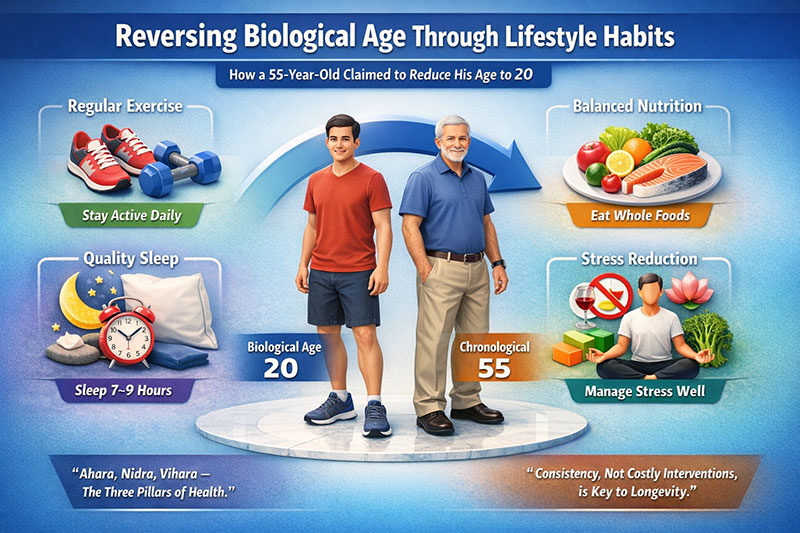
The Economic Times recently reported an intriguing and highly popular story of a 55-year-old individual who claims that his biological age has now begun to resemble that of a 20-year-old. What is so attractive about this particular story is not the promise of futuristic medicine or high-priced anti-aging interventions but rather that this has allegedly been achieved by very basic everyday habits. Human biologist Gary Brecka told The Economic Times that a very basic approach has been employed in this technique.
Ageing in current gerontology entails the distinction between the number of years one has been alive, known as the chronic age, and the biological age related to the efficiency with which one’s cells and organs work. In contrast, biological age is determined by genetics, although the impact of lifestyle on the rate at which we biologically age is increasingly being supported by studies in the field of epigenetics, including the study of the clock for DNA methylation that has been published in the journal Nature Aging.
The Importance of Basic Habits
One of the most effective methods of healthy ageing is physical exercise. Exercise and weight training help to maintain muscle mass, improve heart function, boost glucose levels, and slow down chronic inflammation; all of which are factors related to ageing. Many population-based observational studies have shown that physically active individuals tend to live longer and spend less time with disabilities.
Sleep and stress management are also as important. When one sleeps inadequately, the hormonal system becomes imbalanced, the immune system fails to function properly, and the rate of metabolic ageing speeds up. Nutrition and hydration, when focused on whole foods and the right amount of micronutrients, are responsible for maintaining the health of cells and their mitochondria.
The ancient wisdom of India phrased it well when it said, “Ahara (diet), Nidra (sleep), and Vihara (lifestyle) are the three pillars of health.” Modern longevity science increasingly echoes this philosophy.
Examples from around the World
“Blue Zones” around the globe, like Okinawa and Sardinia, are living proof of a lifestyle for extended longevity. They don’t pursue youth viciously; rather, they move their bodies by traveling on foot, eat a diet with little processing, sleep in harmony with nature’s cycles, and have a strong sense of connection within their communities. The traditional lifestyle of rural India similarly included a regimen of physical activity, a simple diet, and early bedtimes.
Internationally, major lifestyle intervention studies, such as those conducted by Dean Ornish and published in JAMA, showed that a comprehensive lifestyle modification program could reverse the indicators of chronic diseases. It is scientific proof that the aging process, as defined by biological decline, is, in fact, partly reversible.
Advantages of Lifestyle-Driven Longevity
The main strength of this approach is that it is accessible. Exercise, healthy eating, good sleep, staying hydrated, and staying away from harmful behaviours can easily be afforded by all. This not only increases life span but also health span, which is the number of years one can live with good functional ability. In terms of public health, it decreases healthcare expenditure.
As Mahatma Gandhi once said, “It is health that is real wealth and not pieces of gold and silver.”
Disadvantages and Necessary Precautions
However, it is important to approach assertions about turning back their biological clocks to 20 years old with caution. The assessment of biological age can differ based on biomarkers selected, and it has no standard measure that fits every human being. The measures are also quite personal and can be affected by family genetics and current health conditions.
The famous parable says: “You cannot straighten a crooked tree overnight. But with care, it is possible to mould its direction.” Changing one’s lifestyle needs consistency for many years. The Wider Implication The value in The Economic Times story comes less from its headline hook than from its underlying theme. “Aging isn’t just a thing that happens to us, it’s also something that we do on a daily basis.” While it seems that the latest advances in medicine offer a solution, the basics of longevity are, paradoxically, anything but extraordinary. And it would seem that it is consistency, regardless of cost, that is the key to living well, to living young.
Dr. Prahlada N.B
MBBS (JJMMC), MS (PGIMER, Chandigarh).
MBA in Healthcare & Hospital Management (BITS, Pilani),
Postgraduate Certificate in Technology Leadership and Innovation (MIT, USA)
Executive Programme in Strategic Management (IIM, Lucknow)
Senior Management Programme in Healthcare Management (IIM, Kozhikode)
Advanced Certificate in AI for Digital Health and Imaging Program (IISc, Bengaluru).
Senior Professor and former Head,
Department of ENT-Head & Neck Surgery, Skull Base Surgery, Cochlear Implant Surgery.
Basaveshwara Medical College & Hospital, Chitradurga, Karnataka, India.
My Vision: I don’t want to be a genius. I want to be a person with a bundle of experience.
My Mission: Help others achieve their life’s objectives in my presence or absence!
My Values: Creating value for others.
Leave a reply






















Leave a reply