
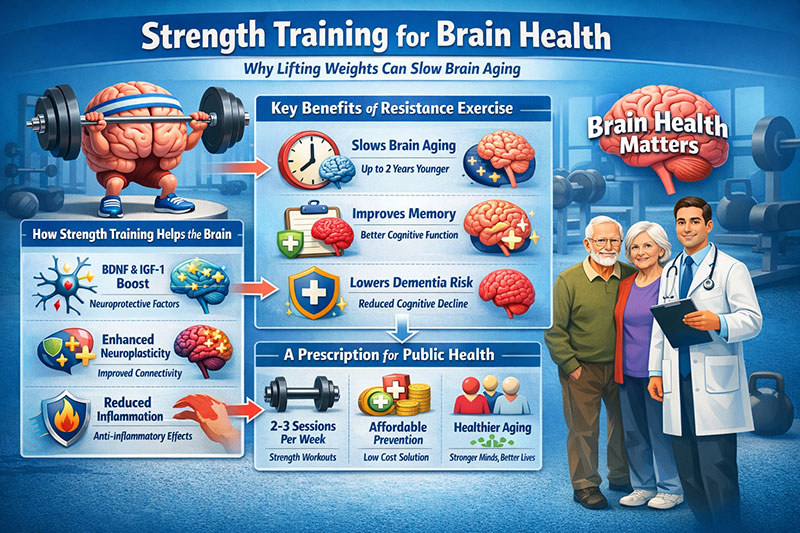
What if a doctor could write a prescription for a barbell instead of a pill? New research in neurobiology is making it clear that resistance training is not just a fad in fitness. It is a neurological intervention that could change the way we think about aging, brain health, and preventative medicine around the world. Healthcare systems need to catch up right awa
The Indian doctor is turning the gym into a clinic.
Dr. Sudhir Kumar, a neurologist at Apollo Hospital in Hyderabad and a graduate of Christian Medical College (CMC) Vellore, is now one of India’s most eloquent advocates for physical fitness and mental health. Based on a randomized controlled research called “Randomised controlled trial of resistance exercise and brain ageing clocks,” he says that regular strength training can make a person’s brain age up to two years younger. The Economic Times published his statement on February 25, 2026, and it was clear: Stop seeing the gym as just a place to work up your biceps. New research backs up what we’ve known for a long time: resistance training is one of the best things we can do for our brains.”
How weights change the brain
The mechanisms are both well-known and amazing. Resistance training causes the brain to release brain-derived neurotrophic factor (BDNF) and insulin-like growth factor 1 (IGF-1). These are substances that help neurons stay alive, strengthen synaptic connections, and encourage neuroplasticity. Dr. Kumar emphasized that these biochemical processes also help keep white matter intact, which is important for good communication between different parts of the brain. Systematic evaluations validate quantifiable improvements in executive function, working memory, and attention span—attributes that deteriorate with aging.
Dr. Wendy Suzuki, a professor of neural science at New York University, has long said that exercise is one of the best ways to improve brain health. She says that its effects are “immediate, long-lasting, and protective.” Her research reveals that resistance training can make the hippocampus, which is the part of the brain that controls memory, bigger.
A Must for Public Health
India is facing a growing neurological catastrophe. The Dementia India Report says that 5.3 million Indians now have dementia, and that number will quadruple by 2050. The WHO says there are more than 55 million cases around the world, with about 10 million new cases per year. Resistance training fights chronic low-grade neuroinflammation, which is a major cause of cognitive impairment. The gym is a type of preventative medication that costs a lot less than treating neurodegenerative illness since it activates anti-inflammatory pathways.
Dr. Kumar’s practical advice is easy to understand: do two to three strength training sessions a week that focus on compound activities like squats, deadlifts, rows, and presses, and make them harder over time to keep your body adapting. But medications for each person aren’t enough. Healthcare systems need to make this information part of their regular operations. In India, this involves including exercise prescriptions in Ayushman Bharat consultations and giving ASHA workers the tools they need to promote formal exercise in rural areas. The UK’s NHS social prescribing initiatives and Australia’s “Exercise is Medicine” program are good examples of how to move forward. They treat exercise with the same clinical rigor as any other medicine.Muscle isn’t only for show. It is tissue that is involved in both metabolism and the nervous system and helps keep the brain healthy throughout time.
In a society where people have a lot of respect for academic achievement, the idea that lifting weights is a way to take care of the mind may really hit home. Deadlifting to remember their grandparents. People who work in offices do rows to get better at making decisions. Students are crouching to help them focus better. These aren’t just made-up pictures; they’re real possibilities that medicine can now prescribe.
The prescription is clear. The science is solid. What is left is the desire—at hospitals, policy chambers, and community centers all around India and the world—to treat the barbell with the same respect we give the stethoscope.
Source: “Lifting weights is brain surgery: CMC Vellore doctor explains how strength training may reverse brain aging” by Dr. Sudhir Kumar (@hyderabaddoctor), The Economic Times (Panache), February 25, 2026.
Based on Dr. Sudhir Kumar’s article in The Economic Times (February 25, 2026)
Dr. Prahlada N.B
MBBS (JJMMC), MS (PGIMER, Chandigarh).
MBA in Healthcare & Hospital Management (BITS, Pilani),
Postgraduate Certificate in Technology Leadership and Innovation (MIT, USA)
Executive Programme in Strategic Management (IIM, Lucknow)
Senior Management Programme in Healthcare Management (IIM, Kozhikode)
Advanced Certificate in AI for Digital Health and Imaging Program (IISc, Bengaluru).
Senior Professor and former Head,
Department of ENT-Head & Neck Surgery, Skull Base Surgery, Cochlear Implant Surgery.
Basaveshwara Medical College & Hospital, Chitradurga, Karnataka, India.
My Vision: I don’t want to be a genius. I want to be a person with a bundle of experience.
My Mission: Help others achieve their life’s objectives in my presence or absence!
Leave a reply

























Leave a reply