
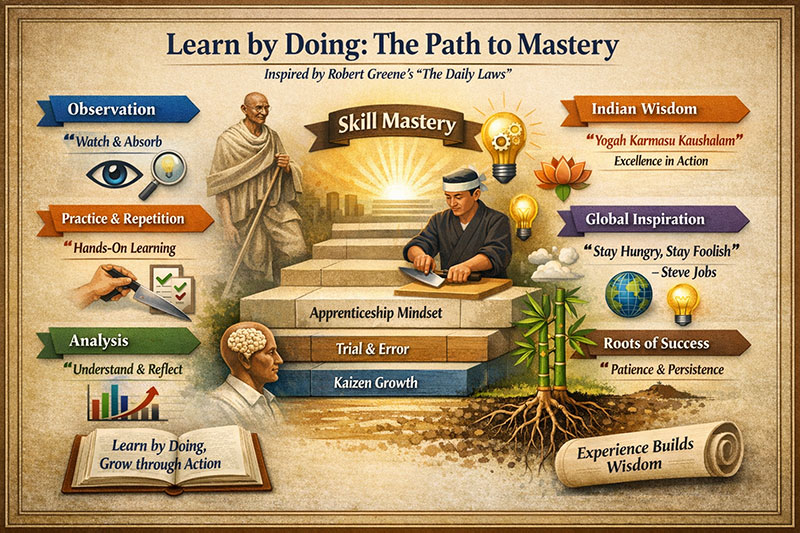
In a world obsessed with credentials, shortcuts, and instant visibility, one quiet truth remains timeless: mastery belongs to those who learn by doing. In The Daily Laws, Robert Greene reminds us that every task, no matter how ordinary, contains the seeds of extraordinary growth. Observation, repetition, and relentless engagement with reality—not passive absorption—shape true expertise.
Formal education often trains us to consume information. We read, memorize, test, and repeat. But real learning begins when theory meets friction. When our hands get involved. When mistakes humble us. When repetition refines us.
Greene writes about the sushi master Eiji Ichimura, who began his career as a dishwasher. No one instructed him. No one mentored him step-by-step. He watched. He absorbed. He practiced knife movements alone during off-hours. Through endless repetition, he carved not just fish—but precision, discipline, and mastery into his own character.
His story echoes an ancient Indian wisdom. The Bhagavad Gita teaches, “Yogah karmasu kaushalam” — excellence in action is yoga. Skill does not arise from contemplation alone; it arises from committed action. A sculptor does not become great by reading about marble. He becomes great by chiselling stone, again and again.
The Apprenticeship Mindset
Every environment has invisible rules—power dynamics, hierarchies, patterns of behaviour. Those who merely perform tasks remain labourers. Those who observe deeply become strategists.
Consider Mahatma Gandhi. Before he became a global moral force, he worked quietly as a lawyer in South Africa. Instead of reacting impulsively to injustice, he observed systems—legal structures, racial hierarchies, political currents. His philosophy of nonviolent resistance was not born in a classroom. It emerged from lived experimentation.
Or reflect on Thomas Edison, who famously said, “I have not failed. I’ve just found 10,000 ways that won’t work.”Innovation, for him, was not theoretical. It was trial, error, correction, repetition.
Learning by doing sharpens reasoning because it connects cause and effect. You see what works, what doesn’t, and why. You begin to notice patterns. Over months—sometimes years—your perception deepens.
Why Passive Learning Falls Short
Modern systems often reward memorization over mastery. We absorb information but rarely test it against reality. This creates what psychologists call the “illusion of competence”—the feeling that we understand something because we’ve read about it.
But can one learn surgery by watching videos? Can one learn leadership by reading biographies alone? Can one learn music without ever touching an instrument?
True competence is embodied. The brain strengthens neural pathways through repetition and sensory engagement. International neuroscientific research consistently shows that deliberate practice reshapes the brain’s architecture. Repetition is not redundancy—it is reinforcement.
The Japanese concept of Kaizen—continuous improvement through small daily refinements—beautifully aligns with Greene’s philosophy. Mastery is incremental. Invisible progress compounds.
The Parable of the Bamboo
There is a well-known Chinese parable about the bamboo tree. For years after planting, nothing visible happens above the soil. The farmer waters it daily. Observers mock him. But underground, roots are spreading deep and wide. Then suddenly, in a short span, the bamboo shoots up dramatically.
What appeared as sudden success was actually patient, unseen preparation.
Learning by doing is bamboo work. Most of your growth is invisible at first. You show up. You repeat. You refine. Others may not notice—but your roots are strengthening.
From Observation to Analysis
Greene emphasizes moving from observation to analysis. At first, you simply watch. You listen more than you speak. You notice the unwritten codes. Gradually, you begin to ask: Why does this system function this way? What larger trends influence it? How do power and incentives operate?
This transition—from seeing to understanding—builds strategic intelligence.
Steve Jobs once said, “Stay hungry. Stay foolish.” Hunger fuels observation. Foolishness keeps you humble enough to keep learning.
The danger in early success is complacency. The moment we believe we “know enough,” growth stagnates.
Find Joy in Relentless Learning
Greene encourages us to find the deepest pleasure in absorbing knowledge. Not for validation. Not for applause. But for expansion.
In Indian philosophy, the concept of Vidya (knowledge) is sacred. Learning is not transactional; it is transformational. The Upanishads remind us: “Let noble thoughts come to us from all sides.” This openness is not passive—it demands engagement.
Mastery is not glamorous. It is repetitive. Often lonely. Frequently misunderstood. But the process itself becomes addictive when you fall in love with growth.
The dishwasher who became a sushi master did not wait for permission. Gandhi did not wait for a political title. Edison did not wait for guaranteed results.
They acted.
A Personal Call to Action
Every task before you today—whether menial or monumental—contains an apprenticeship. Observe deeply. Practice deliberately. Reflect analytically.
Instead of asking, “How quickly can I finish this?” ask, “What can this teach me?”
Instead of seeking instruction, seek immersion.
Instead of fearing repetition, embrace refinement.
As Robert Greene teaches in The Daily Laws, mastery is not bestowed; it is constructed—through months and years of relentless doing.
The world belongs not to those who merely consume information, but to those who convert experience into wisdom.
So stay hungry. Stay observant. Stay relentless.
Because greatness is not learned in theory.
It is carved—one deliberate action at a time.
Dr. Prahlada N.B
MBBS (JJMMC), MS (PGIMER, Chandigarh).
MBA in Healthcare & Hospital Management (BITS, Pilani),
Postgraduate Certificate in Technology Leadership and Innovation (MIT, USA)
Executive Programme in Strategic Management (IIM, Lucknow)
Senior Management Programme in Healthcare Management (IIM, Kozhikode)
Advanced Certificate in AI for Digital Health and Imaging Program (IISc, Bengaluru).
Senior Professor and former Head,
Department of ENT-Head & Neck Surgery, Skull Base Surgery, Cochlear Implant Surgery.
Basaveshwara Medical College & Hospital, Chitradurga, Karnataka, India.
My Vision: I don’t want to be a genius. I want to be a person with a bundle of experience.
My Mission: Help others achieve their life’s objectives in my presence or absence!
Leave a reply
























Leave a reply