
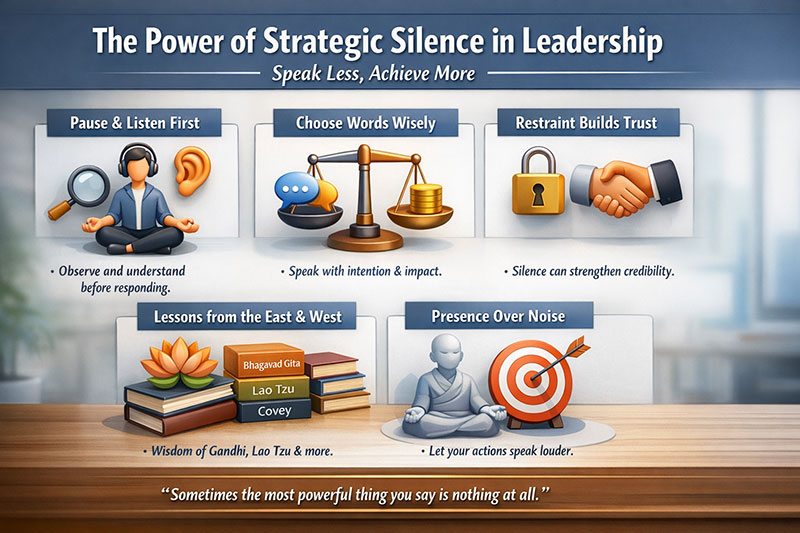
In the modern day and age, where the importance of continuous expression through social media, public speaking, debating, and pitching is emphasized and encouraged, it might be considered contradictory and counterintuitive to propose that the most impactful act of communication that any leader might engage in is the act of remaining silent. This concept was proposed by Joy Chinwendu Nwachukwu on Linked In, who argued that many founders believe that leadership is about filling every silence, justifying every argument, and defending against every challenge.
However, the most successful leaders who have built lasting and enduring enterprises tend to engage in more sophisticated and evolved behaviours. This concept is also consistent with the leadership principle that has been around for centuries and has been exhibited by leaders of different cultures and times. Lao Tzu’s quote that “He who knows does not speak; he who speaks does not know” is more an affirmation of the fact that strategic silence enhances the power of the spoken word rather than an affirmation that the spoken word is irrelevant and ineffective per se.
From Silence as Strategy to Discursive Practice
The act of speaking in leadership and entrepreneurship is always costly because it attracts attention and shapes the way that people view the leader. Therefore, strategic silence is an act of disciplined behaviour. Many founders feel the need to immediately address any criticism, disagreement, or misunderstanding that they might be subject to. However, the most effective leaders tend to pause and reflect on the situation and also listen attentively before speaking and ensuring that the words that they use are strategic and purposeful. Confucius proposed the concept of strategic silence as an effective leadership strategy centuries ago when he said that “Silence is a true friend who never betrays.”
A modern-day example is Satya Nadella, who led Microsoft to focus on listening rather than speaking, thereby creating an environment of empathy and thoughtful dialogue within the organization. Microsoft, under Satya Nadella’s leadership, changed from competition to collaboration within the organization itself. This is how restrained leadership can change organizational culture.
A Parable: The Empty Cup
A famous Zen parable is given to explain this principle. Once, a scholar sought wisdom from a Zen master. The scholar talked extensively about his own knowledge and wisdom. Meanwhile, the Zen master was pouring tea into the scholar’s cup until it was filled to the brim. The scholar then said to the master, “Stop pouring tea into my cup. The cup is already full.”
The Zen master then said to the scholar, “Just like your cup is filled to the brim with your own knowledge and wisdom, you are already filled. How am I going to demonstrate wisdom to you unless you first empty your cup?”
Too much talking from a leader can result in an environment saturated with one’s own voice. By listening and being silent, space is created for wisdom to emerge.
The Indian Tradition: Thoughtful Speech
Indian traditions place great emphasis on thoughtful speech. In the Bhagavad Gita, self-restraint is considered an important aspect of wisdom. “True wisdom is characterized by self-restraint,” says the Bhagavad Gita. “True speech is honest, useful, and timely. Unthoughtful speech destroys relationships and is a barrier to wisdom. Thoughtful speech catalyzes change and awakens wisdom within us.”
Another famous Indian spiritual leader, Mahatma Gandhi, used to keep silent for long periods to attain wisdom. He said that silence helped him to attain wisdom and understand his purpose in life. He said, “In the attitude of silence the soul can find the path in a clearer light, and what is destined to be done will be easier achieved.”
Listening as a Leadership Advantage
Strategic restraint is used to build trust. By listening to people and then responding, leaders are able to build strong relationships.
Stephen R. Covey captured the importance of this principle in the following simple words: “Seek first to understand, then to be understood.”
In the context of negotiations and communications generally, the most effective communicators tend to be those who communicate the least. They ask questions that uncover motivations and responses that reveal the true nature of the concerns. They also tend to communicate more accurately and less emotionally.
The Discipline of Temporal Choice in Speech
The strategic use of silence in speech is not about avoiding confrontation of difficult issues or avoiding the expression of important thoughts. Rather, it is about choosing the appropriate time to communicate. The distinction between reaction and response is critical. A reaction is an emotional and spontaneous expression. A response is more thoughtful and considered.
Experienced leaders understand that they do not always need to offer a response to every criticism levelled against them. They also realize that they do not always need to offer a correction to every disagreement they hear. Finally, they realize that they do not always need to offer a reaction to every provocation. The strategic use of silence is about withholding responses that offer no significant value. Thus, the presence of the leader is more important than the words that the leader uses. The presence of the leader is more important than the frequency of the leader’s speech. The presence of the leader is more important than the content of the leader’s speech. The presence of the leader is more important than the leader’s voice.
The observation credited to Joy Chinwendu Nwachukwu captures the importance of the fact that the most impactful voice is not always the loudest. Enduringly impactful leaders tend to be those who exercise the strategic use of silence. They tend to be the ones who watch and listen more and speak less. They tend to be the ones who speak only when they have something of significant value to contribute to the dialogue. In a noisy environment, the strategic use of silence is not about being timid. Rather, it is about being wise. Sometimes the most impactful speech is the one that is not made.
Dr. Prahlada N.B
MBBS (JJMMC), MS (PGIMER, Chandigarh).
MBA in Healthcare & Hospital Management (BITS, Pilani),
Postgraduate Certificate in Technology Leadership and Innovation (MIT, USA)
Executive Programme in Strategic Management (IIM, Lucknow)
Senior Management Programme in Healthcare Management (IIM, Kozhikode)
Advanced Certificate in AI for Digital Health and Imaging Program (IISc, Bengaluru).
Senior Professor and former Head,
Department of ENT-Head & Neck Surgery, Skull Base Surgery, Cochlear Implant Surgery.
Basaveshwara Medical College & Hospital, Chitradurga, Karnataka, India.
My Vision: I don’t want to be a genius. I want to be a person with a bundle of experience.
My Mission: Help others achieve their life’s objectives in my presence or absence!
Leave a reply




























Leave a reply