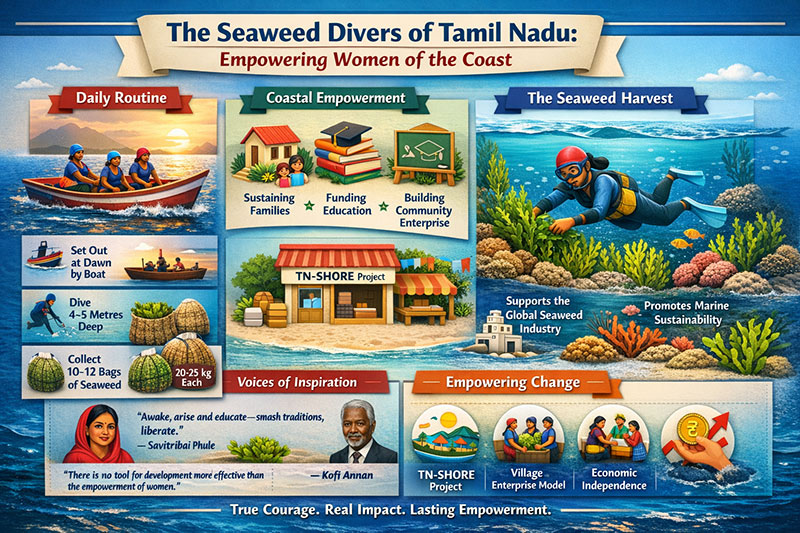
In the Tamil Nadu coast, particularly in the Ramanathapuram district, which includes Pamban, Keelakarai, and Ervadi, there are a number of women who show great courage in carrying out their activities along the coast. Before the sun rises, a group of eight to ten women fishermen venture into the sea in small vessels, carrying out their activities of collecting seaweed from the sea floor, which lies as deep as four to five meters below the sea level.
By mid-morning, they return to shore, carrying bags of seaweed, known as “kacha” in local parlance, weighing as much as 20-25 kilograms per mesh bag, with each of the women carrying 10 to 12 bags of the same. This shows the great courage of the women, who are not only entrepreneurs but also labourers, carrying out activities in a risky environment but still showing great determination in carrying out activities that are beneficial to the community, particularly to the women themselves.
A great but overlooked aspect of women’s empowerment in India: Economic Empowerment of Women
Economic empowerment of women in India is a great but overlooked aspect of women’s empowerment in the country, as seen in the activities of the women fishermen of the Tamil Nadu coast, who show great courage in carrying out activities of collecting seaweed, a crucial activity carried out by the women of the area, who are not only entrepreneurs but also labourers, carrying out activities in a risky environment but still showing great determination in carrying out activities that are beneficial to the community, particularly to the women themselves.
The Government of Tamil Nadu has recognized this potential through the TN-SHORE Project, which aims to create a Village Enterprise Model, which is crucial because economic empowerment of women has a ripple effect on health, education, and other aspects of societal development.
Economist Amartya Sen has stated unequivocally: “Nothing, arguably, is as important today in the political economy of development as an adequate recognition of women’s participation and leadership.” This view is in keeping with the dominant view in the field of development economics. Development economists are in agreement that the more women contribute to the economy, the faster the progress in society. A study done by the World Bank found that the more women contribute to the workforce, the better the well-being and the faster the economic growth in the country (World Bank, 2012).
The seaweed gatherers in the district of Ramanathapuram are an example in this regard. Their work contributes to the growing economy and the growing global seaweed industry. The Food and Agriculture Organization (FAO) has reported rapid growth in the global seaweed industry in recent decades. It has described the industry as a multi-billion-dollar industry (FAO, 2020). Therefore, the women in India are in a strategic position in the growing blue economy. The blue economy is the growing economy that combines the principles of sustainability and ecology.
It has been mentioned in the text that the women in the story are involved in the skill of skin-diving in the open sea. It requires considerable physical endurance and skill in navigating the sea and the terrain in the sea. This skill has been acquired over the years in the community in the coastal districts. The women involved in this work are examples in challenging the gender roles and the roles assigned to women in society. They are examples in challenging the roles assigned to women in society and in demonstrating considerable skill and leadership in the community.
Savitribai Phule was a prominent social reformer in India in the early days and was an advocate for women’s education. She proclaimed: “Awake, arise and educate—smash traditions, liberate.” Although the context in which the quote was issued was in the context of education, the quote is in keeping with the theme in the story in the context of the women and the work they are involved in as a liberating force in society.
Similar scenarios worldwide show how women’s empowerment contributes to local economies when opportunities are provided. For example, in Zanzibar, women who participate in seaweed farming have been empowered to improve their household earnings. According to IUCN (2017), which investigated women’s economic empowerment in coastal areas, women in these areas are empowered to improve marine biodiversity when these businesses are well managed.
Thus, the TN-SHORE Project in Tamil Nadu is not merely a livelihoods project; it is an expression of the recognition that there is a need to incorporate gender equity into the process of coastal development. This is because such projects can enable the transition from informal employment to formal entrepreneurship through the women’s organizations and value chains.
On the occasion of International Women’s Day, the seaweed gatherers in Ramanathapuram district in Tamil Nadu serve as an apt reminder that the process of women’s empowerment is not merely the outcome of the policies and discourses that have sought to empower women; it is the outcome of the early morning hours spent gathering seaweed on boats and in communities that embody the values of resilience and dignity.
Kofi Annan, the former Secretary-General of the United Nations, has aptly stated that “there is no tool for development more effective than the empowerment of women.” The seaweed divers in Tamil Nadu embody this statement in the way they conduct their activities.
This is not merely an account that deserves recognition as a tribute to the hardworking communities in the coastal districts; it is an account that deserves recognition as an example that can be used by policymakers, economists, and leaders across the world as an example of the empowerment that can be achieved through the sustained effort and determination of these women.
Dr. Prahlada N.B
MBBS (JJMMC), MS (PGIMER, Chandigarh).
MBA in Healthcare & Hospital Management (BITS, Pilani),
Postgraduate Certificate in Technology Leadership and Innovation (MIT, USA)
Executive Programme in Strategic Management (IIM, Lucknow)
Senior Management Programme in Healthcare Management (IIM, Kozhikode)
Advanced Certificate in AI for Digital Health and Imaging Program (IISc, Bengaluru).
Senior Professor and former Head,
Department of ENT-Head & Neck Surgery, Skull Base Surgery, Cochlear Implant Surgery.
Basaveshwara Medical College & Hospital, Chitradurga, Karnataka, India.
My Vision: I don’t want to be a genius. I want to be a person with a bundle of experience.
My Mission: Help others achieve their life’s objectives in my presence or absence!
References
- World Bank. World Development Report 2012: Gender Equality and Development. Washington DC: World Bank; 2012.
- Food and Agriculture Organization (FAO). The Global Status of Seaweed Production. Rome: FAO; 2020.
- International Union for Conservation of Nature (IUCN). Gender and Coastal Livelihoods: Case Studies from the Indian Ocean. Gland, Switzerland: IUCN; 2017.



Leave a reply