
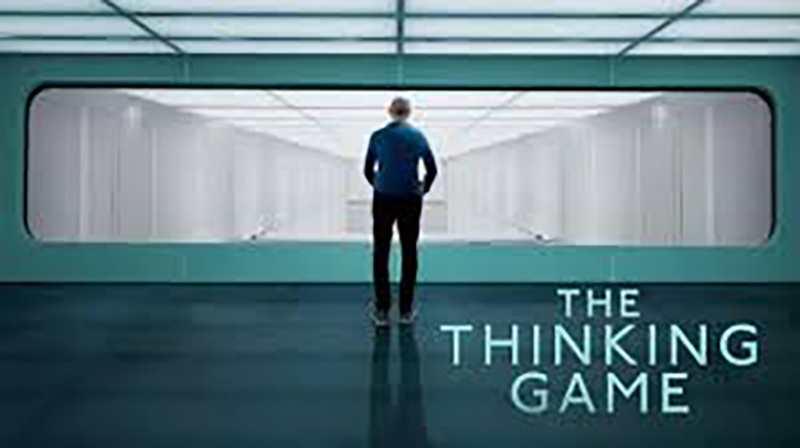
Another documentary that piqued my interest during my recent flight aboard Emirates to Dubai is “The Thinking Game.” What initially started out as entertainment during the flight soon escalated into an intellectual and emotional journey. As it turns out, this documentary goes beyond the developments that have been accomplished in the field of artificial intelligence; it tackles the human preoccupation with knowing intelligence and, by extension, life. It was even more interesting to me because I had earlier watched the video The AlphaGo Movie and written a blog post about it — A video that drove me to the edge of my seat!.
“The Thinking Game is an inside look at DeepMind, showing more than five years of a team tackling an aggressive goal: solving the underlying secrets of intelligence and using them to tackle humanity’s most difficult scientific challenges. This documentary is reflective, slow-paced, and astonishingly candid about uncertainty and doubt – traits that never make it to fame when covering technological developments.”
The focus is on Demis Hassabis and his incredibly eventful life as a child prodigy in chess, a neuroscientist, and a video game designer is what constitutes the philosophy of this movie. Hassabis in the movie is depicted as a non-traditional founder who is always focused on technological vision rather than product or financial gain. One of the most notable quotes that open the movie is: “It’s the solution of intelligence that leads on to the solution of everything else.”
This ambition, which borders on the impossible, will be the thread that runs through this documentary.
The first half of the film looks back at DeepMind’s success in the strategy games, especially AlphaGo. Instead of emphasizing their triumph over the world’s greatest human champions such as Lee Sedol, The Thinking Game looks back on these accomplishments as milestones. In playing games, the outstanding aim wasn’t necessarily to beat the world’s best but to create an arena where the capability of the machine to learn, generalize, and develop intuition would be tested.
This ambition is brought vividly alive in the context of AlphaFold. The documentary meticulously tracks the efforts put forth by a team in resolving the protein folding problem. It is a challenge that remained outstanding for the last 50 years, and its significance is immense as it can revolutionize medicine and the life sciences. The tone, however, shifts considerably here, becoming less triumphant and more delicate. It is asserted, “Science rarely is a thrilling story. It’s a story that’s incremental, and it’s invisible.”
Hassabis puts this phenomenon perfectly: “Real breakthroughs come from sticking with a problem long after the excitement has worn off.”
In the end, when AlphaFold does finally succeed and makes predictions about the structures of proteins to a previously unattainable level of accuracy, the movie resists the impulse towards spectacle. Instead, there is no grand moment of triumph, only one of stunned disbelief and gradual comprehension. The implications are staggering, ranging from the acceleration of drug development to the rewriting of the rules of biological inquiry.
As an area of science and technology, it is safe to say that The Thinking Game is superior in its ability to communicate complex messages without losing any of their detail. Concepts like reinforcement learning, neural networks, and proteins all are described in ways that are graphic and easy to understand.
It is the philosophy of ambition that makes this documentary especially motivational. Hassabis puts forward a much-needed antidote to short-term thinking: “If you pick problems that are important enough, even small advances are significant.” In such a world where speed and instant gratification are the order of the day, this message has great relevance—to technologists, to researchers, to teachers, to practitioners of every kind who are working in uncertain territory.
With its recent launch at the Tribeca Festival and highly successful international tour, “The Thinking Game” remains an important work to this day. It serves as an important reminder that what lies at the heart of every algorithm and every breakthrough is another human being: people thinking, people failing, people persevering. It is, at the end of the day, much more of a documentary about human curiosity and much more of an observation about the human capacity to ask questions that may take an entire lifetime to answer.
Dr. Prahlada N.B
MBBS (JJMMC), MS (PGIMER, Chandigarh).
MBA in Healthcare & Hospital Management (BITS, Pilani),
Postgraduate Certificate in Technology Leadership and Innovation (MIT, USA)
Executive Programme in Strategic Management (IIM, Lucknow)
Senior Management Programme in Healthcare Management (IIM, Kozhikode)
Advanced Certificate in AI for Digital Health and Imaging Program (IISc, Bengaluru).
Senior Professor and former Head,
Department of ENT-Head & Neck Surgery, Skull Base Surgery, Cochlear Implant Surgery.
Basaveshwara Medical College & Hospital, Chitradurga, Karnataka, India.
My Vision: I don’t want to be a genius. I want to be a person with a bundle of experience.
My Mission: Help others achieve their life’s objectives in my presence or absence!
My Values: Creating value for others.
Leave a reply






















Dear Dr. Prahlada N. B Sir,
🌟 Your review of "The Thinking Game" documentary is a masterclass in insightful storytelling! The way you weave together Demis Hassabis' journey, AlphaGo's triumphs, and AlphaFold's groundbreaking achievements is nothing short of captivating. Your reflections on the documentary's themes – the pursuit of intelligence, the power of perseverance, and the importance of tackling grand challenges – resonate deeply.
The quote that struck me was: "It's the solution of intelligence that leads on to the solution of everything else." 🌟 Hassabis' vision is both audacious and inspiring, reminding us that even small advances can be significant when tackling monumental problems.
Your writing style is engaging, and your passion for learning shines through. Thank you for sharing your thoughts on this remarkable documentary, Sir 🙏.
Warm regards 😊
Reply