
In a thought-provoking commentary published in The Times of India, OpenAI CEO Sam Altman outlines why India stands at a pivotal juncture in the global artificial intelligence revolution. In the article titled “India has a head start on AI. Now it needs these 3 things to make it work,” Altman argues that India is not merely adopting AI—it is becoming “the world’s largest real-world test of what AI does to opportunity at scale”. His insights, published in one of India’s most widely read newspapers, deserve careful reflection from policymakers, technologists, educators, and business leaders alike.
India’s Early Advantage
Altman notes that India has already built extraordinary momentum. With 100 million weekly active users and the second largest user base globally after the United States, India is no passive observer in the AI race. The country also has the largest number of students using ChatGPT worldwide and ranks fourth globally in the use of Prism, a research collaboration tool.
These statistics are more than numbers—they reflect a demographic dividend meeting digital acceleration. In a country where over half the population is under 30, AI is not viewed with suspicion but as a pathway to upward mobility. As Altman writes, access, adoption, and agency must align to ensure that AI becomes a tool for millions, not a privilege for a few.
India’s optimism about technology has historical roots. From the IT services revolution of the 1990s to Aadhaar-enabled digital public infrastructure, India has demonstrated an ability to scale digital solutions at population level. AI now represents the next chapter.
The Three Imperatives
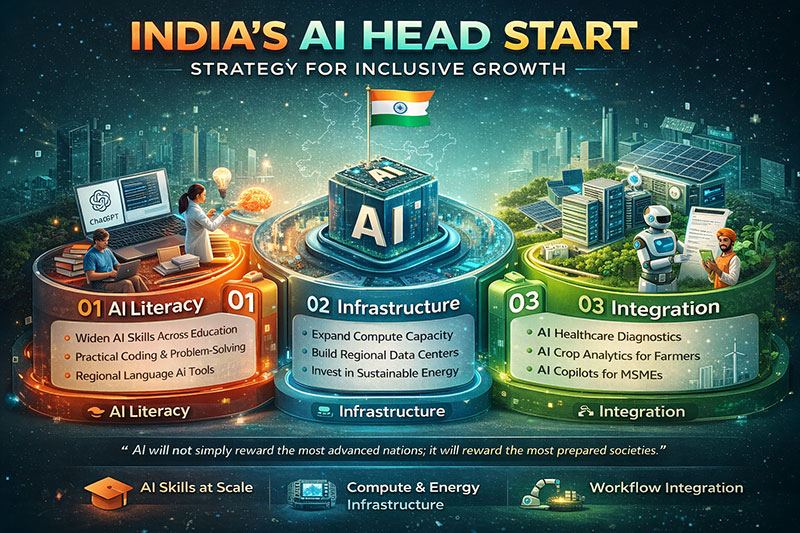
Altman identifies three decisive priorities: AI literacy, infrastructure, and workflow integration. Each carries strategic implications.
1. AI Literacy at Scale
AI literacy, as defined in the article, goes beyond superficial familiarity. It means practical fluency—using AI to write, analyse, code, plan, and solve real-world problems.
From an Indian perspective, this is both an opportunity and a warning. The country’s vast educational network—from IITs and AIIMS to tier-3 colleges—can embed AI skills across disciplines. Imagine medical students using AI to synthesise clinical research, farmers leveraging AI-driven advisory tools in regional languages, or MSMEs using AI copilots to optimise inventory and cash flow.
However, unequal literacy risks what Altman calls a “capability overhang,” where access exists but expertise does not. Internationally, we have seen similar patterns. In the United States and Europe, enterprises with strong digital cultures are capturing disproportionate productivity gains. If India fails to democratise skills, AI could deepen existing socio-economic divides.
A quotable insight here might be: “Access opens the door; literacy decides who walks through it.”
2. Infrastructure: Compute and Energy
AI runs on compute power and energy. Altman emphasises that infrastructure is destiny. Countries that invest in high-performance computing clusters, data centres, and sustainable energy grids will shape the future of AI.
India’s IndiaAI Mission, referenced in the article, aims to expand compute capacity and accelerate multilingual applications. This is strategically sound. But execution will determine impact.
Globally, the AI arms race is heavily infrastructure-driven. The United States invests billions in semiconductor supply chains. China has built national AI labs with state-backed supercomputers. The European Union is funding AI factories and sovereign cloud initiatives.
India must respond with public-private partnerships, domestic chip design initiatives, green energy integration, and regional data centres to prevent over-dependence on foreign infrastructure. The advisory message is clear: AI sovereignty is not optional; it is foundational.
3. Integration into Real Workflows
Altman’s third priority—embedding AI into real workflows—is perhaps the most transformative. AI adoption accelerates when it enhances existing work rather than adding complexity.
In Indian healthcare, AI-powered diagnostics can assist radiologists in high-volume districts. In agriculture, predictive analytics can improve crop yield decisions. In governance, AI chat interfaces can simplify citizen services in multiple Indian languages.
Internationally, productivity gains are strongest where AI augments daily work. For example, legal firms using AI drafting tools report significant time savings; manufacturing units applying predictive maintenance AI reduce downtime. India’s advantage lies in its scale: small improvements multiplied across 1.4 billion people translate into massive aggregate gains.
A powerful line from the article states that when access, adoption, and agency align, people participate “not just as users of AI, but as builders and beneficiaries of the growth it enables”. This encapsulates the democratic promise of AI.
Trust and Democratic AI
The article also emphasises trust, safeguards, and responsible deployment. This resonates deeply in a democracy as large and diverse as India. Youth protections, institutional clarity, and regulatory transparency must evolve alongside technological capability.
India has a unique chance to define what “democratic AI” looks like at scale. Unlike more centralised models elsewhere, India’s pluralistic governance and vibrant civil society can shape AI norms rooted in inclusion and accountability.
As Altman concludes, “AI will help define India’s future, and India will help define AI’s future”. That is not mere rhetoric—it is a strategic reality.
Advisory Outlook
India’s head start is real. But leadership requires deliberate action:
- Embed AI literacy across school, university, and professional curricula.
- Accelerate compute and renewable energy infrastructure.
- Incentivise AI integration in MSMEs, healthcare, agriculture, and governance.
- Develop regulatory frameworks balancing innovation with safety.
- Foster indigenous AI research while partnering globally.
The global AI transformation is not a sprint but a marathon. India has begun strongly. Whether it converts momentum into sustainable advantage depends on how effectively it scales literacy, infrastructure, and trust.
In acknowledging Sam Altman’s contribution and The Times of India for amplifying this national conversation, one truth stands out:
“AI will not simply reward the most advanced nations; it will reward the most prepared societies.”
India has the preparation within reach. The next steps will determine whether it shapes the AI century—or merely participates in it.
Dr. Prahlada N.B
MBBS (JJMMC), MS (PGIMER, Chandigarh).
MBA in Healthcare & Hospital Management (BITS, Pilani),
Postgraduate Certificate in Technology Leadership and Innovation (MIT, USA)
Executive Programme in Strategic Management (IIM, Lucknow)
Senior Management Programme in Healthcare Management (IIM, Kozhikode)
Advanced Certificate in AI for Digital Health and Imaging Program (IISc, Bengaluru).
Senior Professor and former Head,
Department of ENT-Head & Neck Surgery, Skull Base Surgery, Cochlear Implant Surgery.
Basaveshwara Medical College & Hospital, Chitradurga, Karnataka, India.
My Vision: I don’t want to be a genius. I want to be a person with a bundle of experience.
My Mission: Help others achieve their life’s objectives in my presence or absence!
My Values: Creating value for others.
Leave a reply



























Leave a reply