
I’ve been sleeping only about five to six hours a day ever since my postgraduate days at the Postgraduate Institute of Medical Education and Research, Chandigarh. Back then, sixteen to eighteen hour workdays were the norm, not the exception, and long, luxurious sleep simply wasn’t an option. That pattern, once ingrained, has stayed with me even today. I still don’t nap in the afternoons.
Yet there’s an interesting paradox. When I do sleep, it is deep, uninterrupted, and restorative. You could have an earth-shattering earthquake outside and I wouldn’t know it. And when I wake up, I feel fresh—clear-headed, energized—like a pearl lifted straight out of seawater.
Over the years, I’ve learned that for people like me, the duration of sleep matters less than the speed and depth with which we enter it. When time is limited, falling asleep quickly becomes the real superpower. That’s when I began actively exploring techniques that help the mind switch off the moment the head hits the pillow.
One method that stood out—remarkably simple yet profoundly effective—is a breathing technique often associated with U.S. Navy SEAL training. These elite soldiers are taught to fall asleep rapidly, even in hostile, high-stress environments. The logic is straightforward: if you can control your nervous system, you can control your state of consciousness.
And that insight takes us straight into the neuroscience of sleep. Because sleep doesn’t begin in the bedroom—it begins in the brain, with the delicate balance between stress circuits and calming pathways. The moment we learn to consciously influence this balance, we stop chasing sleep… and start allowing it to happen.
In a world fixated on sleep aids, cold showers, technology, and biofeedback, the idea that one of the most elite fighting forces in the world utilizes something far more simple, and seemingly archaic, as the breath, is almost disconcerting. When listening to accounts from Navy SEALs, the term ‘breath control’ is presented as the component utilized by Navy SEALs to quickly drift off to sleep, even while in the midst of battle conditions.
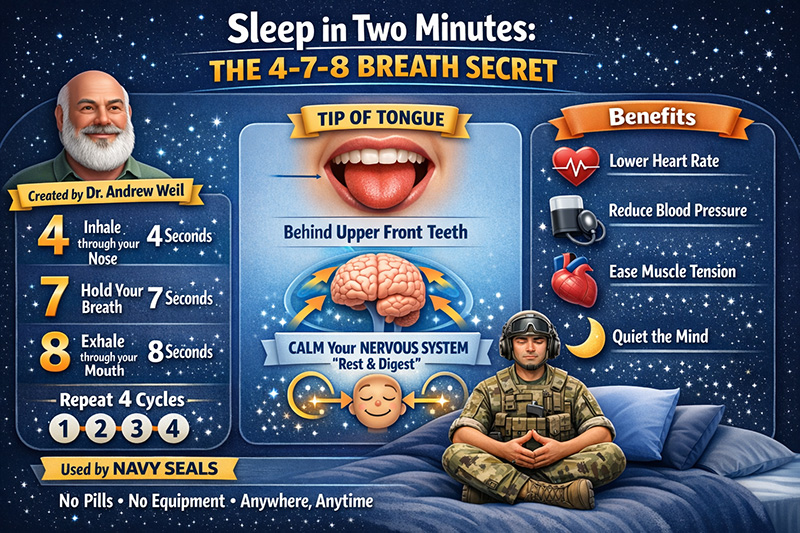
The foundation of this practice is based on the use of the 4-7-8 Breathing Technique, made famous by Andrew Weil. Although very easy to do, this is actually one of the most effective techniques for settling the nervous system and preparing the mind for sleep.
The routine itself is almost beautiful in its simplicity and ratios. Breathe in quietly through your nose for a count of four. Breathe hold for a count of seven. Then breathe out audibly through your mouth for a count of eight, making a soft “whoosh” sound. This is repeated for a total of four rounds. That, of course, is the “magic ratio” of 4-7-8.
A key to the difference is a minor detail: where you position the tongue. Place the tip lightly on the ridges behind your upper front teeth and hold it there for the entire exercise. The exhalation goes around the tongue, so the breath is slowed even further and, almost imperceptibly, relaxation increases. It feels strange the first time, as it should, and, as with anything, practice makes it more familiar and, by extension, more comforting.
How does this approach work so effectively? Because breathing is the only bodily process that is both autonomic and voluntarily controlled. As soon as you start trying to control the process, you can tap directly into your autonomic nervous system. The long, slow exhale associated with the 4-7-8 technique stimulates the parasympathetic aspect of the nervous system, the “rest and digest” response, turning the physiology away from the fight-or-flight response.
As the cycles continue, heart rate decreases, blood pressure gradually falls, muscle tension dissolves, and internal dialogue weakens. It truly feels as if one is slowly removing their foot from the accelerator and then pressing the brake pedal. Contemporary neuroscience validates this: prolonged breath out increases parasympathetic nerve function, leading to better emotional regulation and relaxation. Even this tiny shift in the ratio of oxygen and carbon dioxide can spark a mild spell of light-headedness, indicating to the brain that everything is, in fact, alright to release.
This wisdom has always resided in ancient Indian thought in the form of the following quote in the Hatha Yoga Pradipika: “When the breath wanders, the mind is unfixed; when the breath is stabilized, the mind becomes stabilized.” The Buddha also declared, “Where there is breathing, there is mindfulness; there is no breathing, there is no mindfulness.”
In an international perspective, philosopher William James said, “The greatest weapon against stress is our ability to choose one thought over another.” The breathing technique of 4-7-8 is very effective in picking and choosing what the mind wants to think by merely offering it a simple math problem.
The brilliance of the technique is how easily it can be practiced. There is no equipment required. It may be practiced sitting or lying down, with eyes opened or closed. It can be practiced just before bedtime, prior to a challenging presentation, when feeling anxious, or when waking up in the middle of the night with a racing mind. It goes wherever one goes.
Consistency is necessary. Dr. Weil’s instruction is to do this exercise twice a day with four cycles. These can gradually increase to eight after a month. It should take four to six weeks to see some results regarding relaxation. Relaxation is experienced from the very first exercise.
Is it going to knock you out instantly each and every time? No. Like any other discipline, such as meditation, yoga, or physical training, it gets better with practice. Once mastered, though, it is used as an “off switch” for the mind. In a world that’s all about noise and stimulation, the 4-7-8 breathing technique is a peaceful act of defiance. A hidden ally in a fight against poor sleep. A guaranteed route to dreamland. Sometimes, all that stands between tired and rested is a conscious breath.
Dr. Prahlada N.B
MBBS (JJMMC), MS (PGIMER, Chandigarh).
MBA in Healthcare & Hospital Management (BITS, Pilani),
Postgraduate Certificate in Technology Leadership and Innovation (MIT, USA)
Executive Programme in Strategic Management (IIM, Lucknow)
Senior Management Programme in Healthcare Management (IIM, Kozhikode)
Advanced Certificate in AI for Digital Health and Imaging Program (IISc, Bengaluru).
Senior Professor and former Head,
Department of ENT-Head & Neck Surgery, Skull Base Surgery, Cochlear Implant Surgery.
Basaveshwara Medical College & Hospital, Chitradurga, Karnataka, India.
My Vision: I don’t want to be a genius. I want to be a person with a bundle of experience.
My Mission: Help others achieve their life’s objectives in my presence or absence!
My Values: Creating value for others.
Leave a reply























Leave a reply