
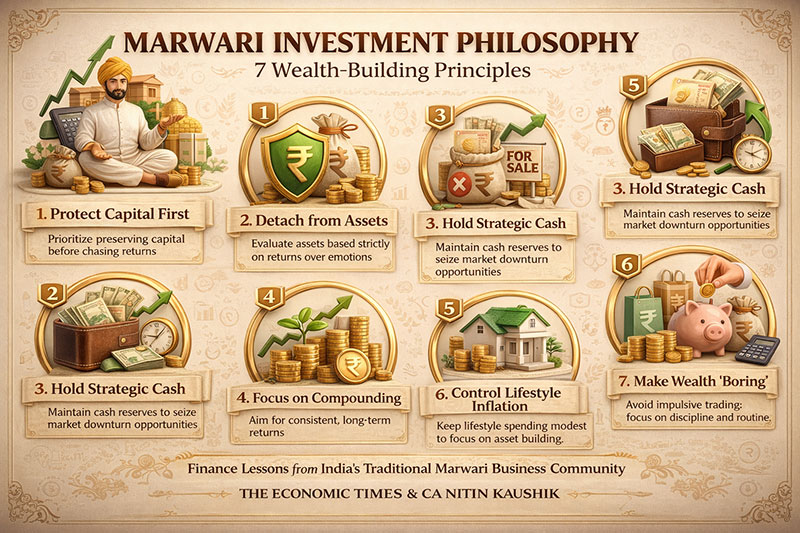
What the Marwari Investment Philosophy can teach today’s investors.
People all throughout the world usually conceive of wealth as massive stock bets, quick profits, and well-known businesses. But being smart with money can help you build some of the most lasting fortunes. The Economic Times recently wrote that the Marwari business community in India has traditionally had a distinct manner of investing that is built on patience, conserving wealth, and self-control. The article talks about what chartered accountant Nitin Kaushik from Delhi thinks.
These principles stem from a certain cultural heritage, yet they are akin to well-known financial tactics like Warren Buffett’s compounding philosophy and Ray Dalio’s risk management frameworks. For modern investors who have to deal with uncertain markets, the Marwari approach is a powerful way to develop long-term wealth.
Keeping capital safe before expansion
The first rule of this framework is simple but important: preserve your capital before you try to make money. The article indicates that Marwari investors normally strive for growth after they know they can get through tough times. You still can’t touch your emergency cash, and you keep your business money separate from your personal money.
This manner of thinking is like a famous quote from Warren Buffett:
“Rule 1: Don’t ever lose money. Always keep Rule No. 1 in mind.”
For example, many Indian businesses in traditional trading districts retain a lot of cash on hand even when the economy is doing well. When things go wrong, such during the COVID-19 pandemic, this form of liquidity allows businesses stay open while their competitors go out of business because they can’t pay their obligations.
This is also supported by global research on behavioural finance. Psychologists Daniel Kahneman and Amos Tversky demonstrated that individuals experience losses more intensely than gains, a phenomenon known as loss aversion (Kahneman & Tversky, 1979). So, keeping your money safe is not only a good financial move, but it also helps maintain your mind stable.
Separation from Assets
Another intriguing thing about the Marwari approach of investing is that they don’t get too emotionally attached to their investments. Investors just care about how much money they can make from their assets, not how much they care about them. The asset is sold straight away if the numbers go down.
Modern retail investors often break this guideline because they become emotionally attached to stocks, companies, or stories. Disciplined investors, on the other hand, see capital allocation as a business decision.
Ray Dalio, a well-known hedge fund manager, said, “The most important thing you can do is be completely open-minded about whether or not you are wrong.”
For example, many family-run trading enterprises in Rajasthan or Gujarat move money between the stock market, real estate, and commodities markets depending on how much money they think they can make. They care about making the best use of their money, not about specific assets.
Opportunity Capital: Cash for Strategy
The essay also talks about how to use money strategically as a third principle. Marwari investors sometimes keep 15–25% of their investments in cash till the market gets better before putting their money to work.
Today’s investing culture, on the other hand, promotes being completely involved all the time. But there are two huge benefits to liquidity:
1. Peace of mind when things are changing.
2. The ability to acquire things for less when the market is down.
When the world economy fell apart in 2008, investors who had cash could buy high-quality stocks for less than they had ever been able to previously. The crash of 2020 during the epidemic also created similar opportunities.
Howard Marks, a well-known investor, remarked, “You can’t predict markets, but you can get ready for them.”
So, cash isn’t just idle capital; it’s optionality.
The Power of Slow Compounding
One of the most important beliefs in Marwari philosophy is that money that comes in slowly is better than money that comes in quickly. Investors don’t want quick profits; they want stable profits over many years.
If you maintain compounding for 25 to 30 years, even little amounts of money can become wealth that lasts for generations. If you put ₹5 lakh into an investment and let it grow at 12% a year, it will be worth more than ₹1 crore in roughly 25 years. This is a math example of why it’s better to be patient than to guess.
Charlie Munger, a late financial thinker, said it beautifully: “The first rule of compounding is to never stop it for no reason.”
Because of this long-term way of thinking, many traditional Indian business families care more about preserving their money safe for future generations than about making money every three months.
How to make money with real estate
Another significant aspect of the Marwari investment idea is real estate. But the focus isn’t on price increases that are based on guesswork; it’s on keeping power and getting steady rental income.
Most of the time, investors only acquire homes if they can retain them for ten years or more without having to worry about money. This careful method makes it less likely that you’ll have to sell when the market goes down.
A lot of trading families in places like Mumbai, Kolkata, and Jaipur own commercial real estate that they rent out and make money from. This property is the financial backbone of their businesses.
Being disciplined in your life and making money
People often forget that managing lifestyle inflation is a key aspect of building wealth. The article suggests that just because you make more money doesn’t imply you should spend more. Building assets should come first; changing your way of life should come later.
People all throughout the world know how to manage their money, and this idea fits with that. Thomas J. Stanley, an American novelist, is famous for saying, “Wealth is more often the result of a lifestyle of hard work, perseverance, planning, and most of all, self-discipline.”
People in many Indian business communities believe this way. They live simply yet still produce a lot of money.
The Quiet Plan of “Boring Wealth”
The Marwari way of thinking says that being rich is meant to be boring. Investors don’t trade all the time; they rely on established protocols, regular investment discipline, and emotional control.
In a time when trading tips and excitement cycles are everywhere on social media, this way of thinking appears nearly against the norm. But history shows that disciplined, long-term investors always do better than traders who act on a whim.
In conclusion, a universal approach for financial success.
The Marwari approach of investing isn’t only a cultural curiosity; it’s also a way of thinking about behavior that is centered on managing risk, being patient, and being disciplined with money. The Economic Times article that mentions Nitin Kaushik claims that getting money is not usually about secret tips or timing the market. Instead, it comes from a disciplined way of investing that includes conserving wealth, keeping cash on hand, embracing compounding, controlling lifestyle inflation, and not getting emotionally involved with investing.
People who want to build long-term wealth need to be disciplined, not excited. This message is clear for investors all across the world, from young professionals in Bengaluru to business owners in New York.
In the long term, the silent method usually wins.
Dr. Prahlada N.B
MBBS (JJMMC), MS (PGIMER, Chandigarh).
MBA in Healthcare & Hospital Management (BITS, Pilani),
Postgraduate Certificate in Technology Leadership and Innovation (MIT, USA)
Executive Programme in Strategic Management (IIM, Lucknow)
Senior Management Programme in Healthcare Management (IIM, Kozhikode)
Advanced Certificate in AI for Digital Health and Imaging Program (IISc, Bengaluru).
Senior Professor and former Head,
Department of ENT-Head & Neck Surgery, Skull Base Surgery, Cochlear Implant Surgery.
Basaveshwara Medical College & Hospital, Chitradurga, Karnataka, India.
My Vision: I don’t want to be a genius. I want to be a person with a bundle of experience.
My Mission: Help others achieve their life’s objectives in my presence or absence!
Leave a reply































Leave a reply