
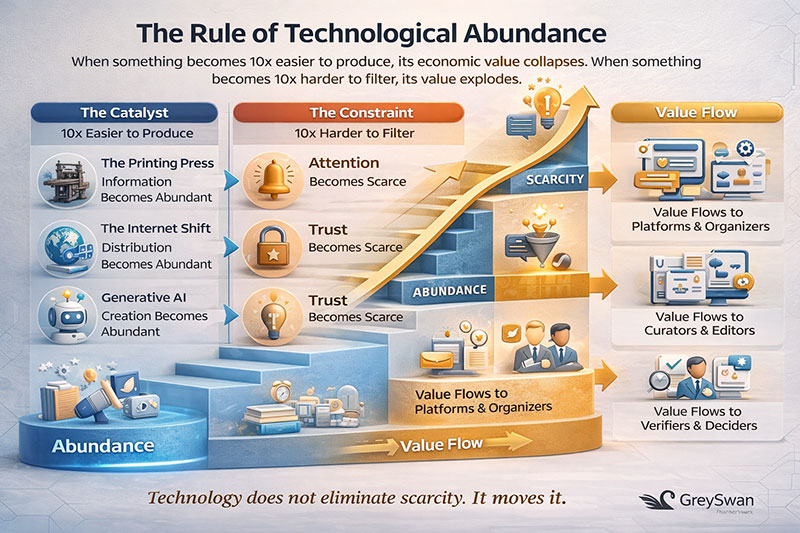
Every major technological revolution promises to democratize power, making production easier, faster, and less costly. However, history always reveals that the true rule at work is that if something gets dramatically easier to produce, its value usually falls, while the capacity to filter, interpret, and judge increases in value. This is the true rule, which the GreySwan framework refers to as “The Rule of Technological Abundance.” This rule explains the phenomenon that, despite the promise of technology, scarcity does not go away, only changes. As production gets easier, value shifts to what still remains scarce.
Throughout the history of human innovation, from the printing press to the internet to the latest phenomenon of generative artificial intelligence, the same rule applies. As production increases exponentially, new scarcity factors arise. These factors take the form of human cognitive abilities, such as attention, trust, taste, and judgment. While technology can speed up execution, flatten hierarchies, and increase the scale of production, it cannot replicate the human capacity for judgment.
The first recorded instance of this phenomenon was when the printing press was invented in the fifteenth century. When Johannes Gutenberg invented movable-type printing, it was much easier to create books and written material. Prior to this, books had been created by hand, a process that was time-consuming. With the printing press, this process was streamlined, and information was suddenly abundant. The problem was, however, that a person could not read all the information available. Suddenly, information was abundant, but attention was scarce. This was captured succinctly by economist and Nobel laureate Herbert A. Simon when he noted, “A wealth of information creates a poverty of attention” (Simon, 1971). Suddenly, editors, scholars, librarians, and educational institutions became important players, as it was their job to filter information. The internet has created another information explosion, this time on a much larger scale. With the invention of digital publishing, it was suddenly possible to disseminate information across the globe, at a marginal cost of close to zero. Suddenly, anyone with access to the internet could create a web page, blog, video, or social media post. This led to a new information explosion, but this time, the scarce resource was not information but trust. Search engines, traditional media outlets, and educational institutions became important tools to navigate this information explosion. This was captured by management guru Peter Drucker when he noted, “The most important aspect of communication is understanding what is not explicitly stated.”
The current revolution in generative AI is following this historical pattern again, in a remarkably similar way. Artificial intelligence systems are now capable of generating text, images, code, music, and designs, and this has dramatically reduced the cost and time necessary to create these things. In fact, creation itself is now becoming abundant. However, this is creating a new kind of scarcity, one in which the ability to know the quality, relevance, and truth of the content is the new advantage. In a world in which millions of articles, images, and videos are now capable of being generated in an instant, the advantage is not in creating the content, but in determining what exists, what is true, and what is irrelevant.
This process of moving from abundance to scarcity has been described by the GreySwan model. In the internet age, distribution was scarce, while attention was abundant. In the generative AI age, creation is abundant, while taste is scarce. This process of progress in computing is likely to continue, so that in the future, execution will be abundant, while judgment will be scarce. The key winners in such an environment are not necessarily the ones who create the maximum amount of material, but rather the ones who filter, authenticate, and assist in decision-making.
A rural Indian scenario would be a good example to describe this principle. Let us consider a farmer who has a huge orchard of mango trees. In the mango season, thousands of mangoes are ready to be picked at the same time. The orchard has abundance, but not all mangoes are equally good. Only a few mangoes are ready, sweet, and ready to be sold in the premium market. The farmer’s skill is not in growing mangoes, but rather in selecting the best mangoes. This principle of abundance in production shifting to abundance in selection is applicable to the digital economy, ideas, information, and even AI-generated material. This process of progress in computing has also led to the “execution shift,” where complex tasks are being executed at a pace that was previously unthinkable. Data analysis, coding, logistics, and even strategy simulations are being executed at a pace that was previously unthinkable. Computers are good at executing, but not at defining a goal or posing a pertinent question. This has been described by computer scientist Alan Kay when he said, “The best way to predict the future is to invent it.”
If the GreySwan model continues to hold true, then the most valuable skills in the coming decades will continue to focus on judgment, discernment, and verification. This means editors in the workplace, clinicians in the medical field, researchers in the scientific field, and leaders in the business world. This means physicians who understand the nuances of the data presented to them by the artificial intelligence systems, journalists who understand the nuance of the information presented to them by the AI systems, and leaders in the business world who understand the nuance of the information presented to them by the AI systems.
The basic insight behind the Rule of Technological Abundance is that technological progress is not a solution to the issue of scarcity; rather, it is a way of moving the issue of scarcity to the next level in the value chain. This means that the printing press made information abundant and attention scarce. The Internet made distribution abundant and trust scarce. Artificial intelligence makes creation abundant and judgment scarce.
The question is, in this world of technological abundance, will success depend more and more on choosing wisely? Execution is abundant, but direction is scarce. The machines will continue to make the slope of productivity steeper and steeper, but the question remains the intercept—the basic question of what problems we want to solve in the first place.
In the age of generative intelligence, the ultimate source of competitive advantage may not be speed, scale, or even automation, but the timeless human capacity for wisdom.
Dr. Prahlada N.B
MBBS (JJMMC), MS (PGIMER, Chandigarh).
MBA in Healthcare & Hospital Management (BITS, Pilani),
Postgraduate Certificate in Technology Leadership and Innovation (MIT, USA)
Executive Programme in Strategic Management (IIM, Lucknow)
Senior Management Programme in Healthcare Management (IIM, Kozhikode)
Advanced Certificate in AI for Digital Health and Imaging Program (IISc, Bengaluru).
Senior Professor and former Head,
Department of ENT-Head & Neck Surgery, Skull Base Surgery, Cochlear Implant Surgery.
Basaveshwara Medical College & Hospital, Chitradurga, Karnataka, India.
My Vision: I don’t want to be a genius. I want to be a person with a bundle of experience.
My Mission: Help others achieve their life’s objectives in my presence or absence!
References:
- Simon HA. Designing organizations for an information-rich world. In: Computers, Communications, and the Public Interest. Baltimore: Johns Hopkins Press; 1971.
- Drucker PF. Management: Tasks, Responsibilities, Practices. New York: Harper & Row; 1973.
- GreySwan Research. The Rule of Technological Abundance framework (conceptual illustration referenced in this article).




























Leave a reply