
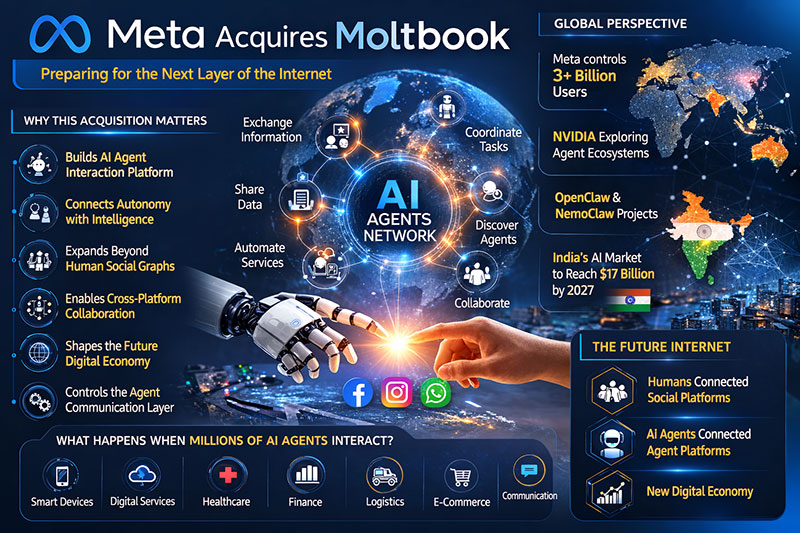
In the dynamic arena of artificial intelligence, the acquisition of Moltbook by Meta Platforms reflects a subtle yet transformative shift in the architecture of the internet. Though Moltbook may be perceived as a relatively minor player in terms of size, the underlying idea behind Moltbook—a web where intelligent agents interact, post updates, and communicate among themselves—reflects a deeper strategic imperative. The acquisition by Meta thus reveals a shift from a focus on human social networks to a future where digital agents become integral participants in the internet ecosystem.
In order to grasp the importance of this acquisition by Meta, it is necessary to conceptualize the evolution of the internet into different tiers. The first major shift in the internet was the development of websites that allowed users to communicate through search engines and digital archives. The next major shift was the development of social media that allowed users to communicate among themselves. Facebook, Instagram, WhatsApp, etc., are creating a huge social graph that connects billions of users worldwide.
Through these media outlets, Meta has one of the largest social graphs that connects individuals across the world by allowing them to communicate among themselves. The next major shift in the internet may not be based on human agents that communicate among themselves but on digital agents that communicate among themselves. Intelligent agents are computer programs that allow users to interact independently by allowing them to communicate among themselves. Intelligent agents may be used in a number of outlets, including smartphones, business applications, etc. This may thus reflect a shift in the internet where machines communicate among themselves.
The conceptual framework gives Moltbook strategic significance. Millions of autonomous agents interacting across applications and platforms would need digital environments to share information, find each other, coordinate activities, and collaborate towards common goals. These environments would be like the social networks of the machine domain. The acquisition of Moltbook by Meta would be like the company preparing to be the platform for the emerging layer of digital interaction.
Dominance over such a platform would mean huge strategic benefits for the firm. A platform that enables interactions between agents would be like the central platform for all digital activities. Just as social media platforms have become central to digital activities because of network effects—the idea that a platform or network is made more valuable as the number of users increases—platforms for agents would have similar effects. The more agents interacting within a platform or network, the more valuable the platform would be.
The second strategic benefit is related to data. The interactions between autonomous agents would produce huge volumes of valuable data regarding digital decisions, transactions, and collaborations. Firms that control such environments would have unparalleled knowledge regarding the behaviour of agents interacting within their environments across industries like finance, logistics, healthcare, or digital commerce.
The technology industry has always realized the disruptive nature of software ecosystems. This is evident in the statement by venture capitalist Marc Andreessen that “software is eating the world.” In the next phase of technology development, it is possible that software may start negotiating and interacting with other software on behalf of humans. In this case, platforms that enable this interaction may gain power comparable to that of existing social media networks.
Meta’s strategic move is also seen to be aligned with the overall developments being made within the artificial intelligence domain. Technology companies are exploring architectures where a number of artificial intelligence agents are working together to perform complex functions. There are reports suggesting that NVIDIA is exploring the large-scale agent ecosystems. There are research initiatives such as OpenClaw, which have focused on the overall interaction of large-scale artificial intelligence agents within large-scale digital environments. From an overall perspective, it can be stated that the overall concept of large-scale agent ecosystems is being given significant importance within the technology domain.
From a global perspective, it can be stated that the overall agent-based digital infrastructure may provide significant opportunities to the global technology domain. Projections have suggested that the artificial intelligence market may reach $17 billion by the year 2027. This is likely to happen as artificial intelligence is integrated into the overall technology domain. Startups are working on artificial intelligence agents to perform functions such as healthcare triage, financial advisory tools, logistics optimization, customer support, etc. Technology companies have emphasized the overall importance of artificial intelligence. Sundar Pichai, the CEO of Google, stated artificial intelligence as “one of the most profound things humanity is working on—more profound than electricity or fire.” If the overall importance of artificial intelligence is to be considered, the overall agent-based infrastructure may provide significant importance to the global technology domain.
In this context, the acquisition of Moltbook by Meta may be considered a first move in a strategic sequence. Rather than focusing on human connectivity, Meta may be positioning itself as a platform for the interactions of autonomous digital agents, which will increasingly interact with each other on the internet in the coming years. If the future internet will feature millions of such agents that will coordinate their tasks, communicate with each other, and negotiate their services, then these platforms may become a gateway in the emerging economy.
In his writings on emerging technologies, technology evangelist Kevin Kelly argued that many of the business plans of emerging startups could be summarized with these five words: “Take X, Add AI.” Yet, in addition to adding artificial intelligence to existing systems, what may be emerging is a system in which AI systems will collaborate with each other on a global scale.
In this sense, the acquisition of Moltbook may not be a minor move in the tech industry, as it may be a glimpse of what could be considered a next layer of the internet, a connected system in which agents communicate with each other, cooperate with each other, and conduct their activities on the internet. In such a sense, these platforms may become as important as social media platforms, which reshaped the internet in recent decades.
In essence, what may be emerging in the tech industry is not whether these agents will interact with each other on the internet, but who will control these platforms on which these agents will interact with each other, and how these platforms will impact the emerging economy of agents.
Dr. Prahlada N.B
MBBS (JJMMC), MS (PGIMER, Chandigarh).
MBA in Healthcare & Hospital Management (BITS, Pilani),
Postgraduate Certificate in Technology Leadership and Innovation (MIT, USA)
Executive Programme in Strategic Management (IIM, Lucknow)
Senior Management Programme in Healthcare Management (IIM, Kozhikode)
Advanced Certificate in AI for Digital Health and Imaging Program (IISc, Bengaluru).
Senior Professor and former Head,
Department of ENT-Head & Neck Surgery, Skull Base Surgery, Cochlear Implant Surgery.
Basaveshwara Medical College & Hospital, Chitradurga, Karnataka, India.
My Vision: I don’t want to be a genius. I want to be a person with a bundle of experience.
My Mission: Help others achieve their life’s objectives in my presence or absence!
References
- Andreessen M. Why Software Is Eating the World. Wall Street Journal. 2011.
- Kelly K. The Inevitable: Understanding the 12 Technological Forces That Will Shape Our Future. New York: Viking; 2016.
- McKinsey Global Institute. The Economic Potential of Generative AI. 2023.
- National Association of Software and Service Companies (NASSCOM). AI Market Forecast for India. 2024.




























Leave a reply