
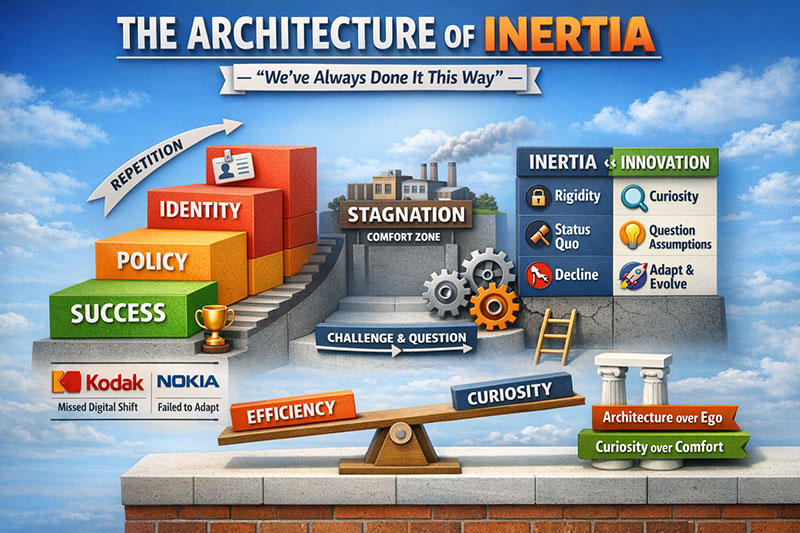
In the world of leadership and business strategy, one of the most dangerous ideas is often the one that quietly slips into the room, almost politely, without much fanfare or even debate. Such is the case with the sentence, commonly used in boardrooms, offices, hospitals, and organizations around the globe: “We’ve always done it this way.” It’s a simple sentence, one that rarely sparks debate or a sense of urgency. Yet it is a sentence that quietly has the potential to become the most expensive sentence ever uttered by an organization.
Organizations do not become stagnant because of failure, at least not dramatic failure. Rather, organizations become stagnant because of success, a success that quietly builds over time. Something works, then it works again, then it works a third, a fourth, a fifth, and a sixth time. It’s a process, a system, a way of doing things that was once a brilliant solution, then a standard operating procedure, then a way of doing things, and eventually a way of being. Once something has become a way of being, it’s difficult to challenge it, almost like a betrayal. No one ever really defends it, yet no one ever really challenges it either. It’s just something that’s always been, something that’s always been passed down.
The renowned management thinker Peter Drucker was one of the first to warn about the subtle danger of success quietly becoming a barrier to progress when he wrote, “The greatest danger in times of turbulence is not the turbulence—it is to act with yesterday’s logic.” Organizations often act with yesterday’s logic because yesterday’s logic was the right way, the way that brought success, the way that brought triumph, the way that brought a sense of pride. But yesterday’s logic, like yesterday’s newspaper, has become history, a history that’s no longer relevant, a history that’s no longer the way things are, a history that’s no longer the way things should be.
Such a phenomenon can be described as the architecture of inertia, built not on bad decisions but on decisions that were once perfectly good. The risk is not that a leader is actively resisting change. The risk is that a leader is so used to success that he or she believes change is no longer necessary. There are many historical examples. The photographic giant Kodak has dominated the world camera market for many decades. The irony is that Kodak engineers actually built the first digital camera back in 1975. The point is that Kodak was reluctant to embrace digital camera technology because its traditional film business was extremely profitable. What was good enough had become a strategic foundation. By the time Kodak tried to change, others had already changed the rules of the game. The story of Kodak is a favorite among scholars of innovation as a prime example of how success leads to inertia, not incompetence (Christensen, 1997).
The story of how Nokia became a leader is also a good example. In the early 2000s, Nokia had a significant market share of the world mobile phone market. The operating models, manufacturing processes, and product development strategies had been incredibly successful. The point is that when smartphones arrived to change everything, Nokia was unable to respond fast enough. The point is that Nokia had become so efficient that it had forgotten to become flexible. As business historian Clayton Christensen wrote in his book *The Innovator’s Dilemma* , companies fail not because they are doing things wrong, but because they are doing things right.
Indian history and philosophy have a great deal to say about the importance of the above theme. In the Bhagavad Gita, leaders are reminded that wisdom is the ability to always know and do the right thing for the circumstances. Lord Krishna instructs Arjuna, “Act with clarity, not attachment.” This is just as important a message for organizations, where attachment to success can lead one to overlook the need to renew.
Ancient Indian parables also demonstrate this truth in action. The parable tells of a farmer who continues to water the dry riverbed because that was where the water had once been. When asked by the neighbors why he was doing this, the farmer replied, “This river has always been here.” The farmer had been doing his part; the problem was that the environment had changed and the individual had not noticed this change.
However, the solution is not in constant disruption and experimentation. Rather, strong organizations develop the quality of curiosity within themselves. This means that these organizations periodically ask themselves if the assumptions that have been made in the past are still valid and if the strategies that have been successful in the past are still valid today.
The renowned Indian industrialist Ratan Tata once stated in an interview, “I don’t believe in taking the right decisions. I take decisions and then make them right.” This statement reflects the philosophy that decisions are made and then changed as the organization learns and becomes more efficient in the process.
However, the real enemy of the organization is not chaos or other competitors in the market. Rather, the real enemy of the organization is the assumption that has been made and has gone unquestioned for such a long period of time that the organization has become comfortable and complacent in its ways and has lost the ability for real and true growth and development in the process.
Therefore, the most important question for the leader of the organization should be: What part of the organization has been around for such a long period of time that it has been around not because it works, but because it worked?
However, the architecture of inertia can be destroyed and the organization can begin its real and true development and growth only if the leader has the courage and the guts to ask the question of the organization and its successes: What part of the organization has been around for such a long period of time that it has been around not because it works, but because it worked?
Architecture over ego. Curiosity over comfort.
Dr. Prahlada N.B
MBBS (JJMMC), MS (PGIMER, Chandigarh).
MBA in Healthcare & Hospital Management (BITS, Pilani),
Postgraduate Certificate in Technology Leadership and Innovation (MIT, USA)
Executive Programme in Strategic Management (IIM, Lucknow)
Senior Management Programme in Healthcare Management (IIM, Kozhikode)
Advanced Certificate in AI for Digital Health and Imaging Program (IISc, Bengaluru).
Senior Professor and former Head,
Department of ENT-Head & Neck Surgery, Skull Base Surgery, Cochlear Implant Surgery.
Basaveshwara Medical College & Hospital, Chitradurga, Karnataka, India.
My Vision: I don’t want to be a genius. I want to be a person with a bundle of experience.
My Mission: Help others achieve their life’s objectives in my presence or absence!
Leave a reply
























Leave a reply