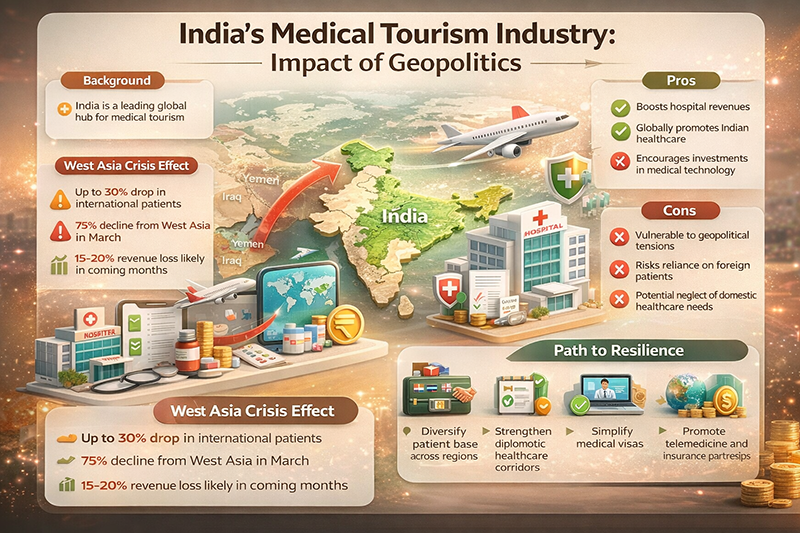
India’s burgeoning medical tourism sector, termed Medical Value Travel (MVT), has traditionally been considered a model industry for other countries. With India offering world-class medical care and treatment at a fraction of the cost of what is incurred in Western countries, the country has emerged as a hub for patients coming in from Asia, Africa, and the Middle East. Recent geopolitics, however, have highlighted the extent to which India’s medical tourism sector is at risk due to global conflicts. According to a report published by Sanket Koul and Shine Jacob on 12 March, “Hospital chains in India have seen a drop of up to 30 percent in the number of international patients, primarily due to the dynamics in West Asia, which has traditionally been a major contributor to India’s medical tourism industry.”
The report goes on to explain that patients coming in from West Asia tend to seek medical care in India for complex medical interventions. According to the Group Chief Operating Officer of Fortis Healthcare, Anil Vinayak, “International patients coming to India from West Asia have seen a drop of more than 30 percent in the recent past due to the conflict in West Asia. If we compare the last ten days of February with the first ten days of March, we have seen a drop of 75 percent in patients coming in from West Asia. There has been a direct financial impact, and our estimates indicate that there has been an immediate drop of 15-20 percent in international medical tourism revenues.”
The medical tourism industry in India has registered consistent growth in recent years. In fact, as per the Federation of Indian Chambers of Commerce and Industry (FICCI) report, the medical tourism industry in India is expected to touch USD 13 billion by 2026, owing to the rise in international demand for medical services and India’s strong reputation in the medical field (FICCI, 2022). However, as can be seen from the current scenario, the medical tourism industry in India remains closely linked with international political stability.
The medical tourism industry in India has several benefits from the perspective of the Indian healthcare industry. In fact, as has been noted by healthcare economist Pratap C. Reddy, who is also the founder of Apollo Hospitals, “India has the potential to become the healing capital of the world because we combine clinical excellence with compassion and affordability.”
However, as can be seen from the current scenario, the medical tourism industry in India also has certain disadvantages. In fact, as has been noted by several critics, the medical tourism industry in India has been prone to certain risks. In fact, as can be seen from the current scenario, the medical tourism industry in India has been impacted by issues like international travel, visas, and currency fluctuations. In fact, as has been noted by the World Health Organization (WHO), while medical tourism can be beneficial from the perspective of the economy, it is also necessary that the healthcare industry remains accessible to the local population (WHO, 2019).
Other countries, such as Thailand, Singapore, Turkey, and the UAE, have developed robust medical tourism systems by diversifying patient sources from various geographical locations. Thailand, for instance, has managed to mitigate possible risks due to conflicts in Europe, the United States, and East Asia. Similarly, Turkey has developed an impressive medical tourism strategy that includes robust government initiatives, airline alliances, and insurance partnerships.
Fortunately, some hospital groups in India are responding positively to the current situation. The article states that Apollo Hospital Group has been actively seeking to diversify patient sources by increasing outreach in other geographical locations, such as Indonesia, Mauritius, Sri Lanka, and parts of Africa. This is an important lesson for hospital groups, as it indicates that medical tourism must be transformed into a global healthcare system.
From a policy point of view, it is an important opportunity for India to reassess its medical tourism strategy in the current context. It is possible to implement various initiatives, such as enhancing diplomatic health corridors, facilitating medical visas, improving patient services, and developing telemedicine services, which might increase resilience. Furthermore, it might be possible to develop partnerships with global insurers and networks, which might increase patient inflows in the current geopolitical environment.
In conclusion, India’s medical tourism story is impressive, and the country has managed to attract patients from all over the world due to its expertise, cost advantages, and growth in the private healthcare sector. However, it is important to realize that, just as other global industries, the Indian healthcare sector is not isolated from global geopolitics. As Amartya Sen, a prominent economist, states, “Health is not only a matter of medicine but also of social, economic, and political arrangements.” The current slowdown might be an important lesson for India, as it might be crucial for the country to maintain a balance between growth and resilience in the medical tourism sector in order to remain at the top in the coming years.
Dr. Prahlada N.B
MBBS (JJMMC), MS (PGIMER, Chandigarh).
MBA in Healthcare & Hospital Management (BITS, Pilani),
Postgraduate Certificate in Technology Leadership and Innovation (MIT, USA)
Executive Programme in Strategic Management (IIM, Lucknow)
Senior Management Programme in Healthcare Management (IIM, Kozhikode)
Advanced Certificate in AI for Digital Health and Imaging Program (IISc, Bengaluru).
Senior Professor and former Head,
Department of ENT-Head & Neck Surgery, Skull Base Surgery, Cochlear Implant Surgery.
Basaveshwara Medical College & Hospital, Chitradurga, Karnataka, India.
References
- Koul S, Jacob S. India’s medical tourism catches a fresh fever. Business Standard, 12 March.
- Federation of Indian Chambers of Commerce and Industry (FICCI). Medical Value Travel in India: Enhancing Value in Healthcare. New Delhi: FICCI; 2022.
- World Health Organization. Medical Tourism and Health System Sustainability. Geneva: WHO; 2019.

























Leave a reply