
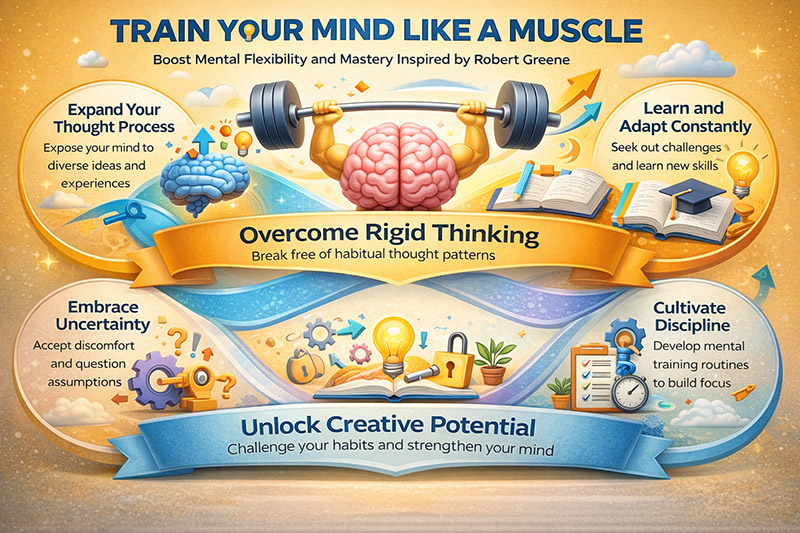
Robert Greene, in his books like “Mastery, and The Laws of Human Nature”, frequently stresses this powerful concept: the mind is not a static entity, but a dynamic tool, similar to a muscle, which becomes more powerful or rigid according to the manner of its use. The snippet of text that you have selected beautifully illustrates this concept. According to Greene, if left unused, the mind naturally “tightens,” meaning it becomes rigid, routine, and resistant to possibilities. This is not a problem of intelligence, but of human nature.
The basic reason for this tightening of the mind is the tendency of a person to favour familiarity. This, as explained by Greene, is because, according to cognitive scientists, “our brains conserve mental energy by favouring ‘cognitive ease,’ by sticking to the mental paths we’ve travelled before, even if they lead only to the same old possibilities” (Kahneman, D. “Thinking, Fast and Slow”. 2011). This can be seen in the manner of professionals who, even when faced with a need for innovation, insist on sticking to what they know, or when people oppose something just because it disturbs their mental stability. As the Indian philosopher Jiddu Krishnamurti perceptively said, “It is no measure of health to be well adjusted to a profoundly sick society.”
The second factor that Greene refers to is the narrowing of focus under strain. This is the tendency to have our focus become more narrow as we intensely concentrate on a problem. While focus is necessary to get things done, too much focus may not be enough to promote creativity. According to psychologist Mihaly Csikszentmihalyi, who wrote extensively on the phenomenon of “flow,” even this intense focus on a problem is necessary but must be balanced with openness to promote creativity. This is in line with what Greene refers to in his book: the more we focus on a problem, the less likely we are to consider other perspectives unless we make a deliberate effort to do so.
This is true in all fields. For example, in the field of medicine, it has been observed that diagnostic errors are caused by premature closure, or the tendency to settle on a diagnosis too soon and not consider other options. Similarly, in the field of business, it has been observed that some firms become so focused on their past success that they fail to innovate and change in response to disruptive technology, such as the case of Kodak and digital cameras. This is all in line with what Greene refers to in his book: the tendency of the mind to become rigid and less likely to consider other options unless we make a deliberate effort to do so.
According to Greene, the way to train the mind is to make it expand. This is in line with the teachings of Indian philosophy. The teachings of the Upanishads refer to the phenomenon of “Neti, Neti,” or “not this, not this.” This refers to the tendency to question and reject all conclusions in order to come to the truth. Similarly, Swami Vivekananda refers to the need to expand our minds to encompass the whole universe.
This perspective is now supported by modern neuroscience. In particular, studies on neuroplasticity show that the brain is capable of reorganizing itself throughout life, creating new neural connections based on learning and experience (Doidge N. The Brain That Changes Itself. 2007). This means that having flexible thoughts is not only a philosophical concept; it is, in fact, achievable at the biological level. By engaging in different activities, learning from different fields, and interacting with different perspectives, the brain is reorganized, effectively combating the “tightening” process described by Greene.
One may cite numerous examples of this. For instance, a medical practitioner who is also interested in art may become better at visual-spatial skills, or an engineer who is interested in philosophy may become better at ethical thinking. Simple acts like traveling, learning a language, or engaging in journaling may also help to break the monotony of our thinking patterns. As Albert Einstein so famously remarked, “We cannot solve our problems with the same thinking we used when we created them.” This is exactly in line with what Greene suggests: to constantly renew the mind.
One may say that ultimately, the message of this book by Greene is to be both cautionary and empowering. The fact of the matter is that the mind’s ability to contract and become rigid is matched only by the mind’s ability to expand and become more expansive. The first step to mastering this is to understand this fundamental nature of the mind. Thus, in today’s rapidly changing world, mental flexibility is not just desirable but has become a necessity. The mind, like a muscle, needs to be trained to become better. As Greene suggests, the end result of this is to not just become better at creativity but also to become better at our psychological lives. The end result of this is to become better at our lives and to rediscover the so-called “original mind,” which is full of life and possibility.
Dr. Prahlada N.B
MBBS (JJMMC), MS (PGIMER, Chandigarh).
MBA in Healthcare & Hospital Management (BITS, Pilani),
Postgraduate Certificate in Technology Leadership and Innovation (MIT, USA)
Executive Programme in Strategic Management (IIM, Lucknow)
Senior Management Programme in Healthcare Management (IIM, Kozhikode)
Advanced Certificate in AI for Digital Health and Imaging Program (IISc, Bengaluru).
Senior Professor and former Head,
Department of ENT-Head & Neck Surgery, Skull Base Surgery, Cochlear Implant Surgery.
Basaveshwara Medical College & Hospital, Chitradurga, Karnataka, India.
My Vision: I don’t want to be a genius. I want to be a person with a bundle of experience.
My Mission: Help others achieve their life’s objectives in my presence or absence!
My Values: Creating value for others.
References:
- Greene R. Mastery. New York: Viking; 2012.
- Greene R. The Laws of Human Nature. New York: Viking; 2018.
- Kahneman D. Thinking, Fast and Slow. New York: Farrar, Straus and Giroux; 2011.
- Csikszentmihalyi M. Creativity: Flow and the Psychology of Discovery and Invention. New York: HarperCollins; 1996.
- Doidge N. The Brain That Changes Itself. New York: Viking; 2007.
- Croskerry P. The importance of cognitive errors in diagnosis and strategies to minimize them. Acad Med. 2003;78(8):775–780.




























Dear Dr. Prahlada N. B Sir,
Your blog post "Train Your Mind, Transform Your Life" is a thought-provoking masterpiece that weaves together insights from psychology, philosophy, and neuroscience, highlighting the mind's capacity for self-transformation. Your eloquent explanation of Robert Greene's concepts and emphasis on neuroplasticity's role in reorganizing our brains is a powerful reminder of our ability to shape our minds.
You beautifully illustrate the need for mental agility in today's fast-paced world, using examples like questioning assumptions (Neti, Neti) and embracing diverse experiences. Your blend of Eastern and Western philosophies, along with modern thinkers, creates a rich tapestry of ideas that inspire and motivate.
Thank you for sharing your wisdom, Dr. Prahlada N. B Sir. Your words have the potential to transform lives.
Reply