
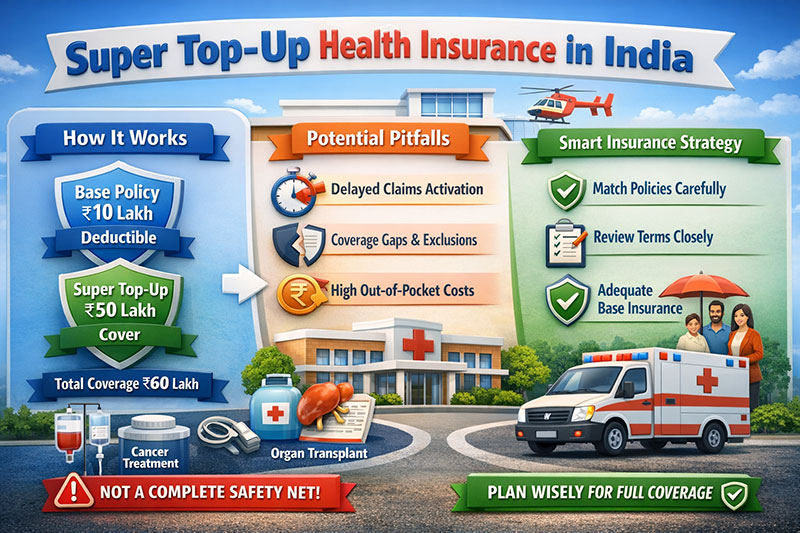
It is pertinent to note that the economics of the medical industry in India is now in a position where “the cost of survival itself may jeopardize financial survival, forcing a re-evaluation of the overall expense structure, pushing the need for a more comprehensive insurance coverage, which in the current market dynamics, may translate into a much higher sum assured plan, upwards of ₹50 lakhs to 1 crore.”
From the aforesaid perspective, the need for a super top-up plan may, in fact, seem attractive, as the proposed insurance coverage amount is high and the additional amount payable is relatively lower.
Super tops-up plans are secondary cover layers that come into effect only after the predetermined deductible amount has been met. This deductible amount is usually synchronized on the sum insured of the basic health plan. The lower cost of the plan is no magic of efficiency, but rather the direct result of limited liability on the part of the health plan provider. The health plan pays for claims only after the aggregate claims in the year amount to the deductible, thereby shifting the bulk of the initial risk back to the buyer of the plan, and thus increasing the chances of gaps in treatment plans for the patients.
In fact, some of the least understood pitfalls relate to the timing and cash flow patterns. Medical billing is not elective; it exceeds cumulative annual limits. Patients undergoing staged cancer treatment or multiple admissions must first exhaust the base coverage prior to super top-up benefits being triggered. “Families may not have the cash flow to provide out-of-pocket relief even if they have high coverage on paper.” The Economic Times article is absolutely right in saying that super top-ups cannot be stand-ins for good base plans but rather merely serve as additional coverage.
Another issue could be discrepancies in terms of coverage. Although insurance companies assure parity, there might still be differences when it comes to exclusion, room rent caps, sub-limits, or specific waiting periods for diseases in base and super top-up policies. IRDAI’s concern about this issue was voiced through several advisories as well as annual reports, as they have stated time and again how policy buyers need to examine terms instead of just looking at the headlines. However, in actual scenarios, this is when, or rather where, many patients learn about such finer points at the billing counter.
In healthcare delivery, there is a behavioural issue as well. Patients with Fragmented insurance systems may defer treatment escalation or hospitalization on account of activation uncertainty. Doctors in oncology and critical care disciplines observe how families negotiate on healthcare choices alongside treatment choices. This is particularly eminent since it impinges on treatment success. Reports cited in the National Health Accounts and WHO health financing reports in India have emphasized insurance burst as a prime source behind treatment default. This is on account of out-of-pocket expenditure.
Having said this, a complete ignore of super-top ups would be a misjudged opinion. A super-top-up, if planned properly, is a viable and helpful facility. In the case of young families and if their sources of income are stable, a wisely quantified base plan of ₹10-15 lakhs along with a super-top-up of ₹50 lakhs or more could indeed be a cost-effective measure providing comprehensive security. The plan should be well-designed.
The key take-away from the advisory is quite apparent. Super top-up plans are an “efficient instrument,” not a safety net solution. Such plans will be most effective as part of a “planned architecture of insurance,” not stand-alone solutions. While policymakers and insurers work to “simplify disclosure,” a cautious mindset is the “key to the use of such plans,”which are essential access tools. With increasing healthcare costs, insurance has ceased being an administrative decision; it has become a clinical risk management tool. “The allure of high benefits at low costs is real—but only for those who read the fine print.”
Dr. Prahlada N.B
MBBS (JJMMC), MS (PGIMER, Chandigarh).
MBA in Healthcare & Hospital Management (BITS, Pilani),
Postgraduate Certificate in Technology Leadership and Innovation (MIT, USA)
Executive Programme in Strategic Management (IIM, Lucknow)
Senior Management Programme in Healthcare Management (IIM, Kozhikode)
Advanced Certificate in AI for Digital Health and Imaging Program (IISc, Bengaluru).
Senior Professor and former Head,
Department of ENT-Head & Neck Surgery, Skull Base Surgery, Cochlear Implant Surgery.
Basaveshwara Medical College & Hospital, Chitradurga, Karnataka, India.
My Vision: I don’t want to be a genius. I want to be a person with a bundle of experience.
My Mission: Help others achieve their life’s objectives in my presence or absence!
My Values: Creating value for others.
Leave a reply



























Leave a reply