
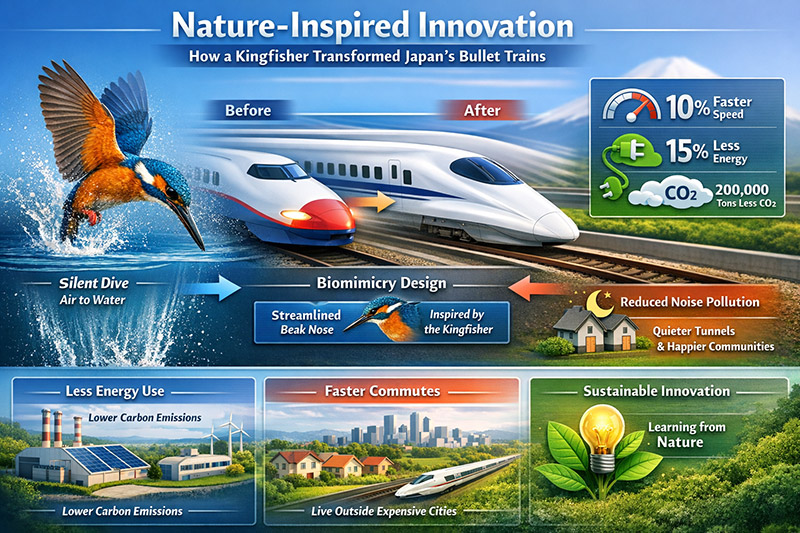
When people think about high-speed rails and Japan’s high-speed rail, in particular, the most obvious feature to consider would be the Shinkansen system. However, at some point in time, this system was facing an interesting challenge that could potentially limit its further development. The issue was that when the trains reached the speeds close to 300 km/h (or 200 mph), the problem of a tunnel boom arose. In order to exit the tunnel at the required speeds, the trains would compress the air in the tunnel, creating a powerful sound wave that would interfere with the residents’ peace and potentially restrict future development through the creation of regulatory constraints. Analysis Engineering analysis shows that, although the problem may seem purely acoustic, in actuality, it appeared due to social and environmental factors limiting the process of technological development (see e.g. Nakatsu E., JR West technical reports; Journal of Sound and Vibration).
The solution to this issue became a prominent example of biomimicry, which involved taking inspiration from nature. The designer of the train’s nose was Eiji Nakatsu, a professional engineer who loved bird watching. His observations showed that kingfishers are able to enter the water almost without making any waves thanks to their unique nose shape that helps minimize the abrupt pressure changes. Thus, he redesigned the train’s nose, giving it similar features.
The outcome of the project was positive and has been extensively researched and published both in JR-West technical reports and academic journals. The new nose helped the trains go 10% faster using only 15% less electricity. The decrease in noise levels allowed the train to meet the necessary environmental standards. All of these achievements coincide with the data available from engineering literature (Schetz & Fuhs, Fundamentals of Aerodynamics; International Union of Railways, energy efficiency report).
However, the significance of such redesign goes much deeper. The decrease in electricity usage of such magnitude implies that, when applied across the railway system of the country, it can potentially lead to hundreds of thousands of tons reduction of CO2 emissions per year, depending on the country and energy mix (International Energy Agency, energy efficiency reports of rail transport systems). In heavily populated countries like Japan or India, even small improvements in efficiency can result in major economic benefits, as it allows extending commute times, decreasing congestion, and affecting urban housing dynamics.
Overall, this story seems to illustrate the concept discussed by Janine Benyus in Biomimicry: Innovation Inspired by Nature. According to her, “nature has already solved many of the problems we are grappling with.” The quote reflects the idea that evolution, as a 3.8 billion-year R&D process, has solved most of the existing problems, which we are simply missing. Another common reference that can be mentioned in this context is Albert Einstein’s quote “Look deep into nature, and then you will understand everything better.”
Indian Reflection From an Indian perspective, this case is quite relevant for many reasons. Indeed, the problems with infrastructure development of the country often rely on the idea of creating more of something, rather than finding alternative ways to achieve goals in a more efficient way. However, the Shinkansen example shows that sometimes it is possible to gain significant advantages just by changing the way processes work. At the same time, there are already many innovations in India itself that involve nature-inspired technology, such as the passive cooling method used in ancient Indian architecture or biomimetic materials created based on lotus leaves (materials science literature).
Of course, such type of innovation requires interdisciplinary collaboration and longer research cycles, along with increased costs. Not all natural analogies can easily transition to engineering applications. Furthermore, industries that operate under tight budget constraints do not usually show willingness to pursue innovations of such nature, as evidenced by engineering management literature (e.g. Dosi G., Technical Change and Industrial Transformation).
Nevertheless, the primary conclusion is clear. The key to success was not to increase power but to minimize resistance and create the system that would match reality. And this idea may become particularly important today when we face ever-growing environmental and social limitations.
Final thoughts
Thus, the main question that should be raised at this point is whether and where this way of thinking is applicable. For example, architectural or healthcare processes are frequently considered successful despite existing inefficiencies and user discomfort. According to the idea discussed here and reflected in design-system studies, the future lies in overcoming these inefficiencies through better understanding of reality.
Dr. Prahlada N.B
MBBS (JJMMC), MS (PGIMER, Chandigarh).
MBA in Healthcare & Hospital Management (BITS, Pilani),
Postgraduate Certificate in Technology Leadership and Innovation (MIT, USA)
Executive Programme in Strategic Management (IIM, Lucknow)
Senior Management Programme in Healthcare Management (IIM, Kozhikode)
Advanced Certificate in AI for Digital Health and Imaging Program (IISc, Bengaluru).
Senior Professor and former Head,
Department of ENT-Head & Neck Surgery, Skull Base Surgery, Cochlear Implant Surgery.
Basaveshwara Medical College & Hospital, Chitradurga, Karnataka, India.
My Vision: I don’t want to be a genius. I want to be a person with a bundle of experience.
My Mission: Help others achieve their life’s objectives in my presence or absence!
My Values: Creating value for others.
References:
- Nakatsu E. The story of the Shinkansen and biomimicry. JR West Technical Reports; various presentations.
- Howe MS. Aerodynamic noise of high-speed trains in tunnels. J Sound Vib. 1998;211(3):441–456.
- Barrett RV. Aerodynamic noise reduction of high-speed trains. J Sound Vib. 1996;193(1):285–292.
- Schetz JA, Fuhs AE. Fundamentals of Aerodynamics. 5th ed. Hoboken (NJ): Wiley; 2011.
- Pope A, Goin KL. High-Speed Wind Tunnel Testing. New York: Wiley; 1965.
- International Energy Agency. The Future of Rail: Opportunities for energy and the environment. Paris: IEA; 2019.
- International Union of Railways. Railway Handbook 2017: Energy Consumption and CO₂ Emissions. Paris: UIC; 2017.
- Benyus JM. Biomimicry: Innovation Inspired by Nature. New York: HarperCollins; 1997.
- Dosi G. Technical Change and Industrial Transformation: The Theory and an Application to the Semiconductor Industry. London: Macmillan; 1984.
- Boyce PR. Human Factors in Lighting. 3rd ed. Boca Raton (FL): CRC Press; 2014.






















Leave a reply