
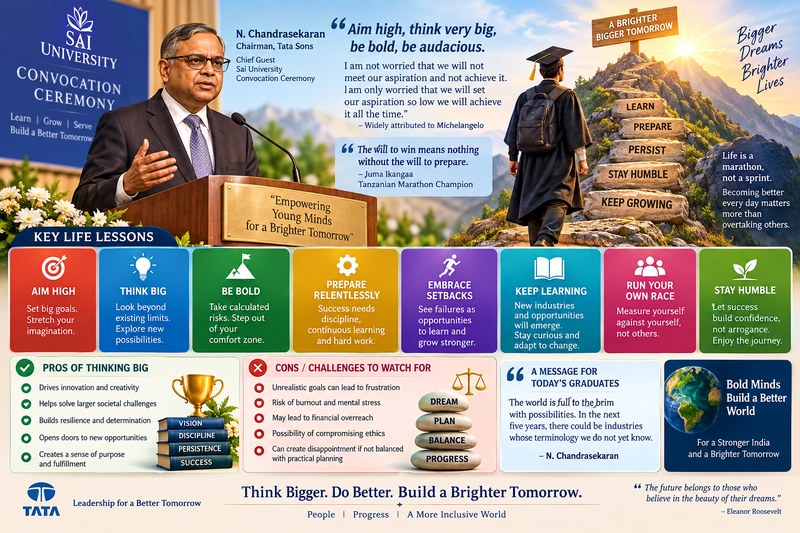
During the third convocation of Sai University located near Chennai, on September 19, 2026, Natarajan Chandrasekaran, Chairman of Tata Sons, addressed the graduating students in a more profound way than a typical advice on obtaining a well-paid job. Based on the experience of many years of corporate management and the experience of a marathon runner, he motivated young people to strive for success combining it with preparation, resilience, and learning for the whole life. Namely, the key idea stated by him was: “Aim high, think very big, be bold, be audacious.”
The career of Chandrasekaran himself proves this idea. Since joining Tata Consultancy Services in 1987, he grew inside the company up to becoming the CEO of TCS and then the Chairman of Tata Sons. Therefore, there is a clear distinction between “thinking big” and expecting immediate success. Aspiration defines the goal; preparation allows us to reach the goal. This idea was perfectly formulated by Chandrasekaran using the words of the Tanzanian champion Juma Ikangaa: “The will to win means nothing without the will to prepare.”
Moreover, Chandrasekaran used a famous quote traditionally attributed to Michelangelo. He said that the main danger is not to aim too high and fall short but to aim too low and succeed. However, a historical note must be made regarding this quote. While the saying is often attributed to the Renaissance master, there is no reliable primary source supporting this claim, and the phrase must be called “widely attributed to Michelangelo.” Nevertheless, the principle drawn by Chandrasekaran from this quote is quite valid. Goals should not only confirm our ability to do something but inspire imagination.
Such a philosophy has a special significance for India. Today’s graduate who starts his/her career has to face the reality of artificial intelligence, automation, climate challenges, and fast-changing business models. Although he/she acknowledges the anxiety caused by technological disruptions, Chandrasekaran is sure that new industries and professions will appear. “The world is full to the brim with possibilities,” he assured the graduates. Within five years, there will be some new industries whose terminology will not be known to us yet. For Chandrasekaran, the reaction to such uncertainty is continuous learning, creativity, and early adoption of new technologies.
There are plenty of advantages of being so audacious. While a student dreaming only of employment prepares for existing jobs, the one who wants to solve India’s problems with the shortage of water, develop cheap healthcare technologies, create sustainable cities or artificial-intelligence companies begins to ask much deeper questions.
Aspiration makes experiments and innovations inevitable. Indian scientific and technological breakthroughs frequently prove that any improbable aspiration turns into a practical project with the help of vision, institutions, knowledge, and persistent work.
However, there is another important aspect of “think big.” Ambition without realism becomes recklessness. Too big goals might lead to burnout, financial failures, disappointments or temptations to achieve goals in a morally questionable way. Similarly, organisations may get obsessed with their grand goals without paying attention to the staff, the environment, and evidence-based signals. Instead, the only way out is to set bigger goals but with much stronger preparation, ethical limits, and interim goals. Chandrasekaran called it “dual races”: achieving short-term goals which will give the momentum to long-term aspirations.
In addition, his metaphor of the marathon race makes the idea very clear. “Life is a marathon race, not a sprint,” he said. But more important than this, the purpose of running is “becoming better by the day, not overtaking others.” Each person has different skills, limitations, and destinations. Consequently, the Chairman advised graduates to “measure yourself against yourself.” In the era of the social media when success is constantly compared to the success of others, this piece of advice can be one of the most valuable lessons for the graduates.
Failures thus obtain a different meaning. Failure does not always mean that the destination was foolish; sometimes it is just the information about what must be changed. Preparation can be improved. Knowledge can be deepened. Strategy can be revised. Chandrasekaran motivated students to perceive pressure as a privilege and obstacles as the chance to make additional efforts rather than an excuse to give up. At the same time, he warned them not to let success turn confidence into arrogance.
Therefore, the message of the convocation of the Sai University goes beyond its graduates. Regardless of whether you are a student, a scientist, an entrepreneur, a teacher, a doctor, an architect, or a public servant, a full life implies having both a horizon and steps. Set goals as high as the failure becomes possible, prepare as much as the progress becomes probable, and stay humble enough to continue learning. Success does not mean reaching the destination but becoming more competent, brave, and useful during the journey.
Thus, Chandrasekaran’s final philosophy can be summarized in a simple formula: “Think big, prepare endlessly, run your own race, learn from failures, and enjoy the journey.” The world does not need people who simply do everything that they can do. It needs people bold enough to do what they cannot do yet but disciplined enough to develop into people who can do it.
Senior Professor and former Head,
Department of ENT-Head & Neck Surgery, Skull Base Surgery, Cochlear Implant Surgery.
Basaveshwara Medical College & Hospital, Chitradurga, Karnataka, India.
My Vision: I don’t want to be a genius. I want to be a person with a bundle of experience.
My Mission: Help others achieve their life’s objectives in my presence or absence!
My Values: Creating value for others.
Leave a reply


























Leave a reply