
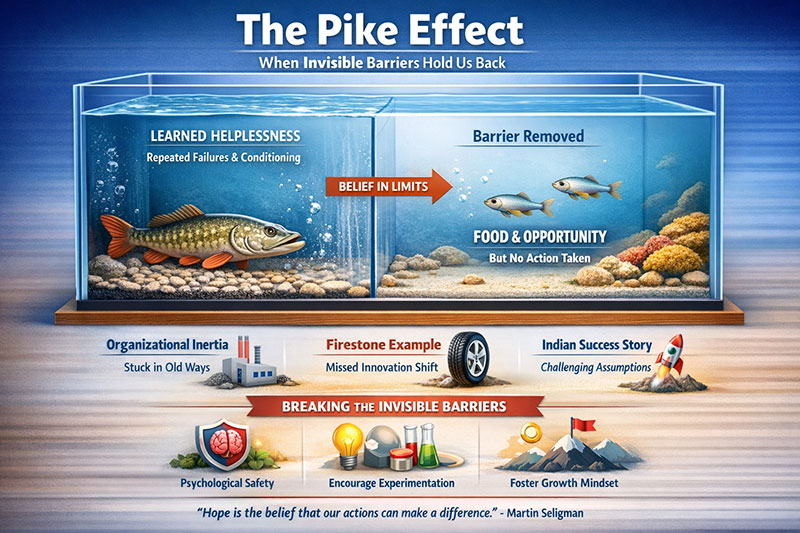
The process of leadership is often defined as the ability to recognize opportunities despite the barriers that may impede them. However, in various organizational settings, the most formidable barriers may not be the ones that are tangible or concrete. The phenomenon most commonly referred to as the “Pike Effect” is an apt metaphor for such a phenomenon. The story of the Pike Effect is based on the premise of a fish that, despite the food available in the environment, perishes as it learns to believe that the food is not attainable. Regardless of whether the metaphor is literal or allegorical, the phenomenon is an apt representation of the psychological phenomenon of how people are limited by barriers that no longer exist.
The most commonly accepted interpretation of the Pike Effect is an anecdotal account of an experiment in which a pike is introduced into an aquarium with smaller fish separated from the pike by a transparent barrier. The pike constantly tries to attack the smaller fish but is constantly thwarted by the barrier. After a series of unsuccessful attempts, the pike gives up. The barrier is then removed, and the pike does not attack the smaller fish despite the fact that there is no longer an obstacle in the way. The fish then dies with food readily available in the environment. The barrier is gone, yet the belief in the barrier persists.
While the exact research lineage of this phenomenon is difficult to trace in the scientific literature, the underlying theory is consistent with the well-documented psychological phenomenon of learned helplessness, as first introduced by Martin E. P. Seligman in the late 1960s. Through a series of research papers using both animal and human subjects, Seligman was able to demonstrate how exposure to uncontrollable adverse situations could lead an individual to believe they had no control over the outcome of an event, even when such control was again made possible (Seligman & Maier, 1967; Seligman, 1975). The essence of the theory is that an individual will not attempt to achieve an outcome not because they are incapable of such an outcome, but rather they have learned to expect failure.
The Pike Effect is particularly relevant in the context of organizational management. For example, in an organizational setting where employees have been repeatedly subjected to criticism or hierarchical barriers, they may gradually cease attempting to introduce new ideas or take the initiative in new situations. Such an effect is particularly visible in an organizational culture where such behaviour was previously discouraged or where risk-taking was actively penalized. Over time, the team or group will internalize the underlying constraints that remain even after the original cause of such constraints has passed.
Historically, there are a number of examples of organizational behaviour that demonstrate such a psychosocial phenomenon. A commonly cited example is the decline of the Firestone Tire and Rubber company in the transition from bias-ply tires to radial tires in the 1970s. Business theorists argue that organizations may not wish to adopt new and potentially disruptive innovations in the belief that past successes will dictate the likely success of new ideas (Christensen, 1997). The failure of Firestone Tire and Rubber to adopt the new radial tire technology resulted in a relative decline in competitiveness compared with those firms that were more willing to innovate. The institutional memory of an organization can thus act as a ‘glass wall’ that prevents an organization from reacting effectively to new opportunities.
Similarly, the business history of India reveals how the removal of such intangible barriers can accelerate the transformation of an industry. The emergence of companies like Infosys in the 1990s, for instance, questioned the conventional wisdom that only countries outside of India could develop globally competitive software companies. By questioning such conventional wisdom and attempting something entirely new, Indian technology entrepreneurs rewrote the country’s economic history, as Infosys co-founder N.R. Narayana Murthy puts it, “Progress is often achieved by questioning what people assume to be impossible.”
However, the Pike Effect should not be seen as a simplistic phenomenon. There is no guarantee that caution or hesitation is necessarily irrational. Organizations may have valid reasons to pass on risk. They may be constrained by legislation, financial constraints, or ethical concerns. In addition, the encouragement of experimentation without sufficient accountability may lead to expensive strategic blunders. Thus, the challenge that faces leaders is how to recognize constraints that may be real as opposed to those that may be psychological.
True leadership involves the systematic destruction of invisible barriers. Research into organizational behaviour has shown that the psychological safety factor, as termed by Edmondson, is important in helping the organization to take risks and voice novel ideas (Edmondson, 1999). When the workforce perceives that errors will be used as opportunities rather than as reasons for dismissal, they are more likely to challenge assumptions.
Thus, the Pike Effect is a useful reminder that the biggest barriers to success often lie between our ears. Repeated experiences of barriers may cause individuals or organizations to reduce their aspirations to prevent further disappointment. Yet, the key to moving forward is the demonstration by the leadership that the perceived barrier of the glass ceiling has indeed disappeared.
Thus, as Seligman later explained in his extension of the original research into the more general field of optimism: “Hope is not merely wishful thinking. It is the belief that our actions can make a difference.” For the leader who is trying to unlock the full potential of the human resource, this may be the biggest motivator.
Dr. Prahlada N.B
MBBS (JJMMC), MS (PGIMER, Chandigarh).
MBA in Healthcare & Hospital Management (BITS, Pilani),
Postgraduate Certificate in Technology Leadership and Innovation (MIT, USA)
Executive Programme in Strategic Management (IIM, Lucknow)
Senior Management Programme in Healthcare Management (IIM, Kozhikode)
Advanced Certificate in AI for Digital Health and Imaging Program (IISc, Bengaluru).
Senior Professor and former Head,
Department of ENT-Head & Neck Surgery, Skull Base Surgery, Cochlear Implant Surgery.
Basaveshwara Medical College & Hospital, Chitradurga, Karnataka, India.
My Vision: I don’t want to be a genius. I want to be a person with a bundle of experience.
My Mission: Help others achieve their life’s objectives in my presence or absence!
References
- Seligman MEP, Maier SF. Failure to escape traumatic shock. J Exp Psychol. 1967;74(1):1–9.
- Seligman MEP. Helplessness: On Depression, Development, and Death. San Francisco: Freeman; 1975.
- Edmondson AC. Psychological safety and learning behavior in work teams. Adm Sci Q. 1999;44(2):350–383.
- Christensen CM. The Innovator’s Dilemma. Boston: Harvard Business School Press; 1997.























Leave a reply