
There is an old parable from a village in Rajasthan. A farmer builds two identical houses — same materials, same size, same cost. One faces east, the kitchen catching the morning sun. The other faces west, the kitchen bathed in afternoon heat. The first family prospers. The second family argues — constantly, inexplicably — until an elderly architect visits and remarks simply: “When the cook is always uncomfortable, the food is made in frustration. And a meal made in frustration is never nourishing.”
Whether you read that as mysticism or ergonomics, the observation is the same: direction shapes how we feel inside a space.
This is the essence of Vastu Shastra — and it is considerably older than the anxiety it sometimes provokes.
The Science Behind the Ancient System
Vastu Shastra, codified in texts including the Manasara and the Mayamata, is India’s classical built-environment science. It predates most modern architectural theory by centuries and operates on a principle that rings true across cultures: the orientation of a space relative to the sun, wind, and earth affects the quality of life within it.
“Architecture is the art of how to waste space.” — Philip Johnson, architect.
Johnson meant it provocatively. But Vastu inverts the sentiment entirely: architecture is the art of how space uses you. Every direction carries consequence. The northeast, called Ishan, is traditionally associated with water, light, and clarity — which is why placing a meditation corner or study in the northeast aligns with both Vastu logic and modern research on how natural morning light improves focus. The south and southwest are associated with stability and rest — which is why the master bedroom in the southwest is not superstition but a practical observation that afternoon sun here is softer and less disruptive to sleep.
The German architect Ludwig Mies van der Rohe said: “God is in the details.” Vastu would add: “And God first arrives from the northeast.”
The Problem That Studio Matrx Solved
Here is what most Indian homeowners do when they want to check Vastu compliance: they either hire a pandit, rely on half-remembered advice from a relative, or simply ignore the whole question and hope for the best.
None of these approaches serve a family that has just invested ₹40 lakhs in a flat and wants clarity, not contradictions.
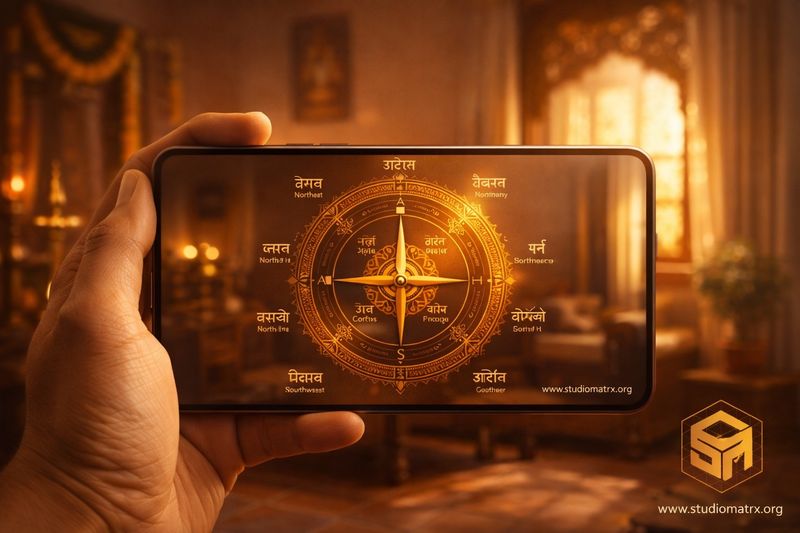
Studio Matrx’s Vastu Compass tool at studiomatrx.org/utilities/vastu-compass changes this completely. It uses your mobile phone’s built-in compass — the same sensor that guides your maps and your camera — to detect the precise orientation of any room in your home in real time. Point your phone at a wall and the tool tells you immediately which direction you are facing, what that direction means in Vastu terms, and what the ideal use of that space should be.
No appointment. No fee. No conflicting opinions. Just the compass your phone already carries, connected to a framework your civilisation refined over three millennia.
What the Tool Actually Tells You
Stand in your living room. Open the Vastu Compass. The moment your phone detects north, the tool maps the traditional Vastu grid — the Vastu Purusha Mandala — onto your real space. It tells you: your prayer corner ideally belongs northeast. Your kitchen is optimally oriented toward the southeast, where the fire element (Agni) has its natural seat. Your bedroom in the southwest gives you the stability and groundedness that the earth element carries.
“The greatest wealth is to live content with little.” — Plato.
Vastu would translate that into built form as: when your home aligns with its natural environment, the mind settles. You need less noise, less stimulation, less excess — because the space itself is quietly doing the work of grounding you.
This is not uniquely Indian intuition. Feng Shui in Chinese architecture, the orientation of Egyptian temples to solar events, the placement of Japanese Shinto shrines along energy lines — every ancient civilisation independently arrived at the conclusion that space has direction, and direction has consequence.
A Tool for the Modern Indian Home
The practical application is straightforward. A couple designing a new 3BHK in Bengaluru uses the Vastu Compass before committing to a floor plan. They discover their preferred master bedroom placement conflicts with the Vastu principle of southwest placement — and makes a small adjustment. Their designer confirms it also improves cross-ventilation. Two benefits, one decision, five minutes on a phone.
A first-time homeowner in Hyderabad moving into a resale flat uses it to decide where to place the prayer unit — a decision that would otherwise require three phone calls and a Sunday afternoon of conflicting advice. The compass confirms the northeast corner of the living room, and she feels the quiet satisfaction of a choice made with clarity rather than compromise.
Studio Matrx’s Vastu Compass is part of a suite of 156+ free tools built for Indian homeowners — because good design decisions should not depend on your budget, your contacts, or your access to an expert.
“A house is a machine for living in.” — Le Corbusier.
If that is true, then Vastu Shastra is the original operating manual. And now, for the first time, it fits in your pocket.
Try the free Vastu Compass and all 156+ design tools at studiomatrx.org
Studio Matrx — India’s first AI-powered interior design & architecture platform. Built in memory of Amogh N P, architect and visionary.
Dr. Prahlada N.B
MBBS (JJMMC), MS (PGIMER, Chandigarh).
MBA in Healthcare & Hospital Management (BITS, Pilani),
Postgraduate Certificate in Technology Leadership and Innovation (MIT, USA)
Executive Programme in Strategic Management (IIM, Lucknow)
Senior Management Programme in Healthcare Management (IIM, Kozhikode)
Advanced Certificate in AI for Digital Health and Imaging Program (IISc, Bengaluru).
Senior Professor and former Head,
Department of ENT-Head & Neck Surgery, Skull Base Surgery, Cochlear Implant Surgery.
Basaveshwara Medical College & Hospital, Chitradurga, Karnataka, India.
My Vision: I don’t want to be a genius. I want to be a person with a bundle of experience.
My Mission: Help others achieve their life’s objectives in my presence or absence!
My Values: Creating value for others.
Leave a reply

























Dear Dr. Prahlada N. B Sir,
What a refreshing and intellectually stimulating perspective you've shared! You bridge ancient Vastu Shastra wisdom with modern tech, reminding us that architecture shapes us as much as we shape it. "The environment we inhabit eventually inhabits us" – profound!
Studio Matrx's work democratizes this science, using our phones to strip away mysticism and bring clarity. The tools, like Vastu Compass, align homes with cosmic rhythms, blending tradition with innovation.
Your dedication and tribute to Amogh N. P. shine through. This isn't just a suite of tools; it's a mission for harmonious living.
Thank you for showing true innovation isn't about discarding the past, but giving it a modern pulse. Looking forward to exploring the Vastu Compass!
With profound respect and admiration, 🙏.
Reply