
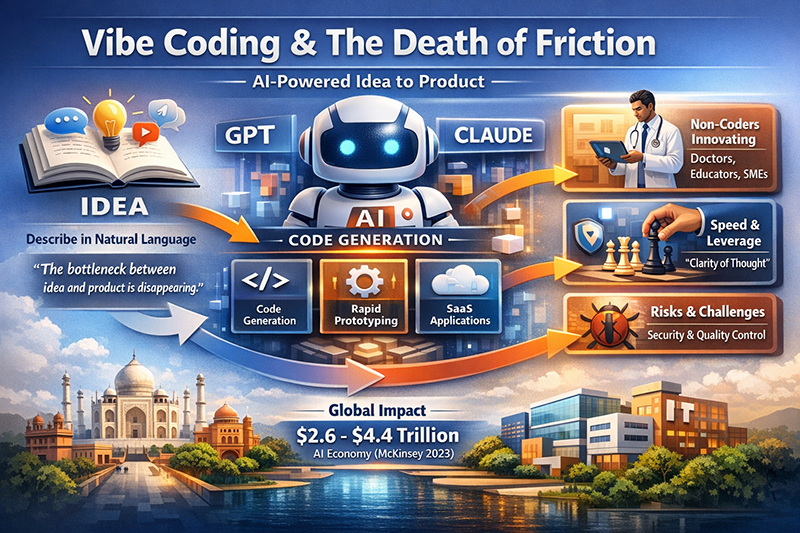
In an informal conversation, Naval Ravikant recently coined an idea that encapsulates the essence of the AI revolution. The concept of “vibe coding” refers to an era where humans simply state their intentions, and AI technology translates these intentions into code. This is more than an economic and technological shift—it is also a creative and democratizing revolution.
In software development, there has always been a barrier between idea and execution. Even for visionary entrepreneurs, software development teams were required to translate their concepts into code. However, today, GPT models from OpenAI and Claude from Anthropic have emerged as viable solutions for creating production-grade code, APIs, and even complete applications using structured inputs. This is more than an economic and technological shift—it is also a creative and democratizing revolution. This technological shift has resulted in an unprecedented reduction of “idea-to-product latency,” as Ravikant himself described it best: “The bottleneck between idea and product is disappearing.”
The economic implications of this shift cannot be underestimated. In their 2023 report, McKinsey & Company estimated that generative AI could contribute between $2.6 trillion and $4.4 trillion annually to the world economy, with software development and automation being key drivers (McKinsey, 2023). This parallels previous technological revolutions, where abstraction technologies such as high-level programming languages and cloud computing have increased participation. However, “vibe coding” is more than an abstraction shift—it is the death of friction. The friction of having to code is eliminated.
What does this mean for India? The implications are significant. The country has a large number of domain experts—in medicine, teaching, architecture, small business management, etc.—who never had access to software development capabilities. Now, with AI-assisted development, a doctor in Karnataka can create a patient management application, or a teacher in rural India can create an ed-tech application, without having to hire programmers. The democratization of creation is shifting power away from technical expertise to cognitive clarity and problem definition. As Ravikant’s philosophy has consistently emphasized, power in this new world is not just held by capital or labour, but by code—and increasingly, by those who can control code through language.
The frictionless world is not without problems, however. One of the significant advantages of vibe coding is that it is fast. Prototyping is quick, and this allows entrepreneurs to rapidly validate their business models with minimal costs. It also makes it easier for new entrepreneurs to enter this space because there are fewer barriers to entry. Finally, vibe coding is also more conducive to interdisciplinary creativity because professionals from non-technical backgrounds can now contribute to product development.
The frictionless world is not without problems, however. One of the significant problems is that software engineering has traditionally been based on a set of checks and balances that ensure that code is reliable and secure. The frictionless world, with code being generated by AI, may not have this in place, and code generated by AI has been known to be less secure or less optimal unless audited correctly (Pearce et al., 2022, IEEE Symposium on Security and Privacy). There is also a danger that with frictionless creation, we may see more low-quality or redundant code being created, thereby diluting the overall value of code in the market.
There is also a deeper cognitive concern. “If execution becomes effortless, the competitive advantage will shift entirely to ideation and judgment.” The bar will be raised for strategic thinking. Ravikant frequently makes the point, “Specific knowledge is found by pursuing your genuine curiosity.” In a world of vibe coding, the thing that will no longer be scarce will be original thinking and ideas. Those who can clearly define meaningful problems and precise solutions will succeed, while ideas lacking depth will become instantly common.
From an international perspective, this trend will reinforce other global shifts toward “no-code” and “low-code” technologies, but with significantly more sophistication. While Silicon Valley may still lead in AI infrastructure, emerging economies such as India will benefit disproportionately due to their population sizes and unmet digital needs. The confluence of affordable computing, ubiquitous internet access, and AI-powered development tools will create a fertile landscape for innovation.
In conclusion, “vibe coding” is an opportunity as well as a challenge. It is an opportunity to spread innovation and entrepreneurship, to create economic value in many industries. It is a challenge to think critically about our responsibilities as we promote this movement. The death of friction does not mean the death of rigor. It simply shifts where we need to focus our energy. While the barriers to creation are lowered, the ones who will succeed will no longer be the ones who can create, but the ones who can think.
Dr. Prahlada N.B
MBBS (JJMMC), MS (PGIMER, Chandigarh).
MBA in Healthcare & Hospital Management (BITS, Pilani),
Postgraduate Certificate in Technology Leadership and Innovation (MIT, USA)
Executive Programme in Strategic Management (IIM, Lucknow)
Senior Management Programme in Healthcare Management (IIM, Kozhikode)
Advanced Certificate in AI for Digital Health and Imaging Program (IISc, Bengaluru). Senior Professor and former Head,
Department of ENT-Head & Neck Surgery, Skull Base Surgery, Cochlear Implant Surgery.
Basaveshwara Medical College & Hospital, Chitradurga, Karnataka, India.
References
- McKinsey & Company. The Economic Potential of Generative AI: The Next Productivity Frontier. 2023.
- Pearce H, Ahmad Z, Tan B, et al. Asleep at the Keyboard? Assessing the Security of GitHub Copilot’s Code Contributions. IEEE Symposium on Security and Privacy, 2022.
- Ravikant N. Informal conversation with Nivi (Naval Podcast / AngelList discussions, widely circulated excerpts).




























Leave a reply