
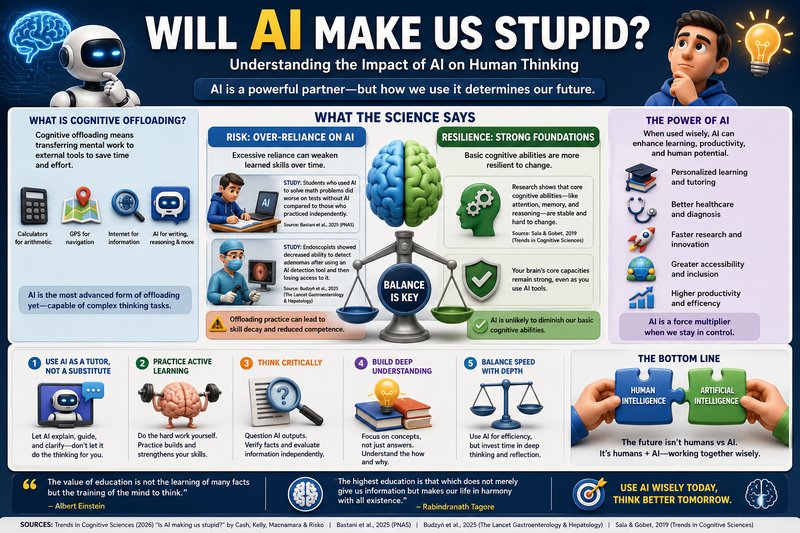
Introduction Nowadays, artificial intelligence plays a crucial role in education, healthcare, research, engineering, businesses, and in everyday life in general. As AI-based applications such as ChatGPT, Claude, Gemini, Microsoft Copilot and others become popular for writing, coding, diagnostics, design and decisions making, one question arises: will AI make us less smart? This topic is discussed in a balanced way by Trent N. Cash, Megan O. Kelly, Brooke N. Macnamara, and Evan F. Risko in their 2026 paper “Is AI making us stupid?” (Trends in Cognitive Sciences). They deserve recognition for raising the topic in a reasonable way and distinguishing true cognitive risks from exaggerated ones.
First of all, the authors state that AI should be viewed as one more example of cognitive offloading—the long-standing human practice of transferring mental efforts on external devices such as calculators, notebooks, GPS navigation, internet and other technologies. However, AI is significantly different as it carries out reasoning, summarization, drafting and problem solving that used to require significant mental efforts. Thus, the main point is not whether AI could help us or not, but whether over-relying on it can lead to our intellectual deterioration.
Scientific evidence provided by the authors shows that the main threat of cognitive offloading is not reducing our natural intelligence, but deteriorating the skills acquired during the learning process. Indeed, learning means practice. When students use AI to solve mathematical problems, they usually demonstrate good results when they are helped by AI, but worse ones when AI cannot be used. The same phenomenon is reported in medicine when doctors using AI-assisted diagnostics systems experience deteriorated performance of diagnostics when AI system is not available. So, the excessive use of AI can lead to skill decay when technology takes place of human activity entirely.
Fortunately, there is also good news. The authors observe that basic cognitive functions—such as attention, working memory, general reasoning—seem to be more resistant to AI impact compared to particular skills learned. Indeed, numerous studies in cognitive psychology show that these fundamental functions are quite resistant and cannot be easily affected by short-term interventions. As a result, while AI reduces proficiency in particular task if its user stops exercising it, AI is unlikely to change the main cognitive structure of the human brain.
AI advantages are numerous. Internationally, AI contributes to scientific discoveries, accelerates drug development, improves medical imaging, helps in legal research, increases accessibility for disabled people and facilitates personalized education. In India, AI is actively used in healthcare under the National Digital Health Mission program, in agriculture for precise farming purposes, in governance for digital public services provision, in education for multilingual teaching and adaptive learning. With its linguistic and unequal access to experts diversity, India has enormous potential in democratizing the knowledge with the help of AI.
However, disadvantages of AI usage also should not be underestimated. Students may become dependent on AI assignments without understanding the concept behind it. Professionals may experience skill decay due to loss of their ability to diagnose and analyze something if AI does the intellectual job instead of them. Researchers may become too dependent on AI summaries instead of reading literature and doing critical analysis. Writers may lose their originality in exchange for convenience. In all these cases, the technology itself is not harmful, but passive use turns AI from learning partner into cognitive replacement.
The main idea from Cash et al. is that the way of using AI is more important than the fact that people use it. If AI works as a tutor explaining, asking questions and giving feedbacks, learning outcomes stay good or even better. On the contrary, if AI just gives a solution that people accept without any thinking, the learning outcomes deteriorate. This should be kept in mind when AI becomes more and more integrated into daily activities of people.
Indian National Education Policy 2020 encourages critical thinking, problem solving and experiential learning. Therefore, AI should support but not replace these goals of education. Indian universities and schools should encourage students to use AI for brainstorming, explanation, revising and simulating while still requiring reasoning, oral examination, practical demonstration and project completion. The same should happen in professional training of doctors, engineers, lawyers, architects and other professionals.
Final thoughts:
The topic under discussion also brings to mind one philosophical statement. As Albert Einstein said: “The value of education is not the learning of many facts but the training of the mind to think.” The same way, Indian philosopher and Nobel Laureate Rabindranath Tagore reminded us: “The highest education is that which does not merely give us information but makes our life in harmony with all existence”. These quotations sound quite actual in the time when information is abundant and rational thinking stays a purely human feature.
In conclusion, AI is neither a threat to our intellect nor a cognitive enhancement guaranteed for sure. It is just a powerful instrument, whose effect depends on rational human usage. The paper by Cash et al. provides convincing arguments that cognitive offloading may affect negatively particular skills if it is indiscriminate, but collaboration with AI can protect human expertise and even enhance it in some cases.
Author credit: This article is based on “Is AI making us stupid?” by Trent N. Cash, Megan O. Kelly, Brooke N. Macnamara, and Evan F. Risko, published in Trends in Cognitive Sciences (2026).
Senior Professor and former Head,
Department of ENT-Head & Neck Surgery, Skull Base Surgery, Cochlear Implant Surgery.
Basaveshwara Medical College & Hospital, Chitradurga, Karnataka, India.
My Vision: I don’t want to be a genius. I want to be a person with a bundle of experience.
My Mission: Help others achieve their life’s objectives in my presence or absence!
My Values: Creating value for others.
References:
Cash, T. N., Kelly, M. O., Macnamara, B. N., & Risko, E. F. (2026). Is AI making us stupid? Trends in Cognitive Sciences. https://doi.org/10.1016/j.tics.2026.06.004
Risko, E. F., & Gilbert, S. J. (2016). Cognitive offloading. Trends in Cognitive Sciences, 20(9), 676–688.
Bastani, H., et al. (2025). Generative AI without guardrails can harm learning: Evidence from high school mathematics. Proceedings of the National Academy of Sciences, 122, e2422633122.
Melumad, S., & Yun, J. H. (2025). Experimental evidence of the effects of large language models versus web search on depth of learning. PNAS Nexus, 4, pgaf316.
Budzyń, K., et al. (2025). Endoscopist deskilling risk after exposure to artificial intelligence in colonoscopy. The Lancet Gastroenterology & Hepatology, 10, 896–903.
Sala, G., & Gobet, F. (2019). Cognitive training does not enhance general cognition. Trends in Cognitive Sciences, 23(1), 9–20.
If you’d like, I can also produce a version optimized for a magazine, newspaper op-ed, academic newsletter, or SEO-focused blog publication.
Leave a reply

























*Dear Dr. Prahlada N. B Sir,*
With folded hands and deep respect, I read your article _“AI and Human Intelligence: Is Cognitive Decline a Real Risk?”_ — and I must say, it is nothing short of a lighthouse in today’s noisy digital storm. 🌊💡
At a time when we are racing to hand over our thinking to machines, you have paused, reflected, and reminded us of the most sacred truth: *technology is a tool, but the mind is the master.*
The way you have balanced scientific evidence with philosophical wisdom is remarkable.
Citing Cash et al. to explain “cognitive offloading,” while weaving in Einstein and Gurudev Tagore — that is the rare blend of *data + dharma + depth* that only a true teacher-physician can offer.
Your words about AI in Indian healthcare, education, and governance show not just clinical insight, but a patriot’s vision — how we can use AI to _democratize knowledge_ without _diluting wisdom_.
The reminder that AI should be a *tutor, not a replacement* is exactly what our students, doctors, and future leaders need to hear today.
Sir, your mission _“Help others achieve their life’s objectives in my presence or absence”_ shines through every paragraph of this piece.
You are not chasing to be a genius. You are building a *bundle of experience* — and generously sharing it so the rest of us can think clearer, learn deeper, and serve better.
Thank you for leading with both science and soul.
Thank you for protecting the human mind in the age of algorithms.
With immense gratitude and admiration,
Reply_From a grateful reader_
Chitradurga 🙏