
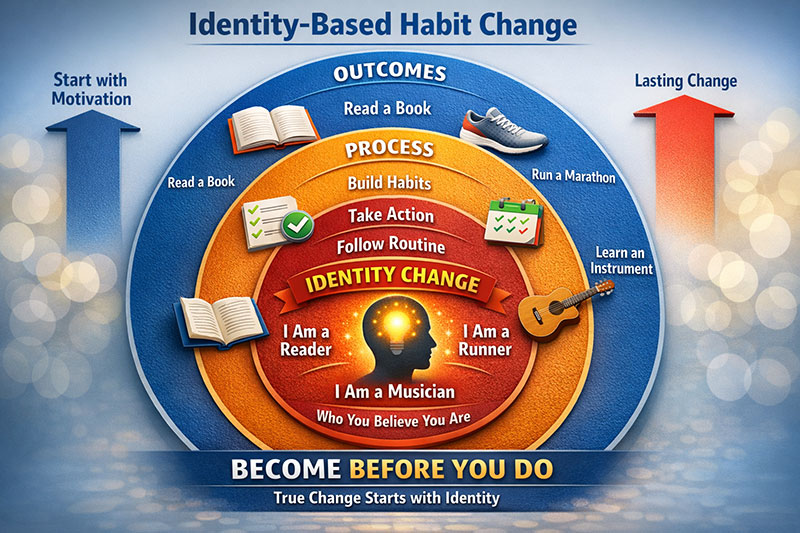
Drawing inspiration from Atomic Habits by James Clear, which emphasizes that lasting change emerges not from setting goals but from reshaping identity, this reflection explores why sustainable habits endure only when they become an integral part of who we believe we are.
But for the vast majority of us, the point of seeking change is to seek actions. We make resolutions, download an app, set goals, and muster up doses of motivation. And for a period of time, we succeed. But then, inevitably, real life gets in the way. The trips to the gym dwindle, the books pile up unread, the guitar collects dust. And this isn’t because of a lack of discipline—it’s the confusion of how real progress actually takes place.
Real change in your behaviour is change in your identity. What begins with motivation will continue only as it is integrated into who you think you are.
Consider this for a moment: It is easy to motivate oneself to eat well for a week and to get up and walk outside twice in the morning. However, until that mindset changes from “I am attempting to be healthy” to “I am a healthy person,” it is likely to be easily broken when it is put to the test. According to a researcher in behaviour, “Outcomes and habits are downstream of identity” (Atomic Habits, 2018, James Clear).
This is why improvements are temporary until they become personal.
The aim is not to read a book.
The objective is to be a reader.
The objective is not to complete a marathon.
The aim is to become a runner.
The aim is not learning a musical instrument.
The aim is to become a musician.
When identity shifts, behaviour follows naturally.
Lessons from Indian Wisdom
The philosophy of India has always stressed ‘being’ over ‘doing’. As the Bhagavad Gita reminds us:
“You are what your deepest, driving desire is. As your desire, so is your will; as your will, so is your deed; as your deed, so is your destiny.”
This particular verse does not glorify lone actions but refers to conviction. Arjuna’s transformation on the battlefield had nothing to do with undertaking a single heroic deed but with embracing his role as a karmayogi, one who acts in terms of his duty and alignment, not for any reward.
Likewise, Mahatma Gandhi once said:
“Your beliefs become your thoughts, your thoughts become your words, your words become your actions, your actions become your habits, your habits become your values, your values become your destiny.”
It is the belief that underlies habit—and belief drives the creation of identity.
The Parable of the Prodigal Son
Here’s a Zen story about two woodcutters. In this story, there are two woodcutters. The first cuts wood every day but grumbles all the time about something that has to be grumbled about. The second cuts wood at a rhythmic pace, taking pride in the job that is being performed. When asked about the difference between them, the second says: “I am a woodcutter.” The first says: “I cut wood to survive.” The same action performed by two individuals with two different identities.
In today’s world, this is easily observed. “I am trying to quit smoking” means struggling with temptation every day. “I am not a smoker” does not negotiate with a temptation. It is easy to identify with.
Global Perspectives on Identity
According to psychologist William James, people act as their self-image dictates. Recently, Carol Dweck, in her work regarding mindset, has identified the fact that people who consider themselves as ‘learners’ last much longer compared to people who just strive for a performance outcome (Mindset, 2006).
This is something that all athletes know instinctively. Olympic runners do not get up every day feeling inspired to run. Instead, they do it because running is what they are. Writers do not write because they get inspired every day to do so. Instead, they do it because they know that they are writers. This is something that Stephen King explains:
“Amateurs sit and wait for inspiration, the rest of us just get up and go to work.”
From Goals to Identity
Goals are useful—they give direction. But identity gives durability. Goals ask, “What do I want to achieve?” Identity asks, “Who do I want to become?”
If you want lasting change, stop obsessing over outcomes and start casting votes for the person you wish to be. Each small action is not just progress—it is evidence. One page read is a vote for being a reader. One run is a vote for being a runner. One honest note played is a vote for being a musician.
Change lasts when behaviour stops being an effort and starts being an expression.
When you become, doing follows effortlessly.
Dr. Prahlada N.B
MBBS (JJMMC), MS (PGIMER, Chandigarh).
MBA in Healthcare & Hospital Management (BITS, Pilani),
Postgraduate Certificate in Technology Leadership and Innovation (MIT, USA)
Executive Programme in Strategic Management (IIM, Lucknow)
Senior Management Programme in Healthcare Management (IIM, Kozhikode)
Advanced Certificate in AI for Digital Health and Imaging Program (IISc, Bengaluru).
Senior Professor and former Head,
Department of ENT-Head & Neck Surgery, Skull Base Surgery, Cochlear Implant Surgery.
Basaveshwara Medical College & Hospital, Chitradurga, Karnataka, India.
My Vision: I don’t want to be a genius. I want to be a person with a bundle of experience.
My Mission: Help others achieve their life’s objectives in my presence or absence!
My Values: Creating value for others.
Leave a reply



















Leave a reply