
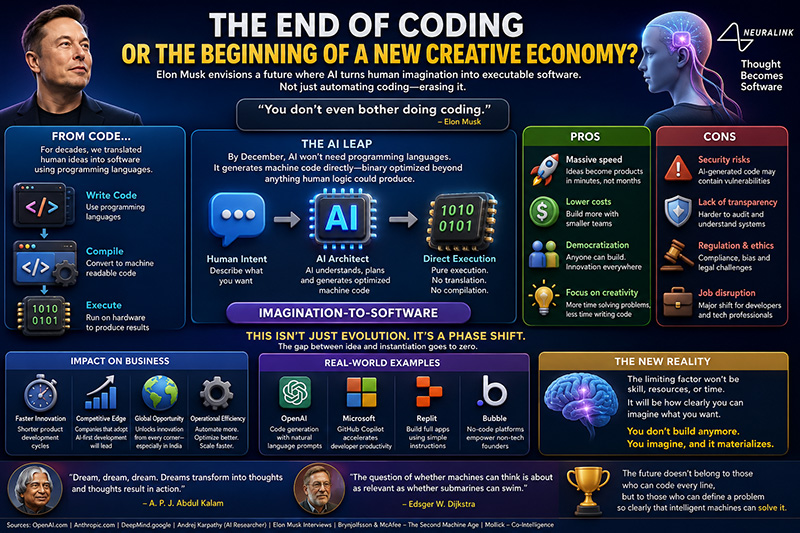
“The future may not belong to those who can code every line, but to those who can define a problem so clearly that intelligent machines can solve it.”
A recent quote reportedly made by Elon Musk has stirred controversy in the tech community. Musk believes that traditional software coding may soon become a thing of the past due to the increasing capability of artificial intelligence systems to create machine-language code through natural instructions. The vision goes even further with the concept of brain-computer interfaces where software is coded not using programming languages and keyboards but through thought alone. Regardless of how far-fetched these projections seem, they beg serious considerations about coding, software development, and innovations in business, education, and creative thinking.
For centuries, programming languages have been used as intermediaries between human instructions and computers’ actions. C++, Java, Python, Javascript, and many other languages were never end goals but means. With advances in AI-generated coding software developed by firms like OpenAI, Anthropic, and Google DeepMind, the ability of software to interpret natural language instructions and translate them to coding appears increasingly possible. Software development may no longer need writing but prompting – a practice known as vibe coding – has already become common.
Economically speaking, software development used to take years of study and extensive knowledge. However, if machines can interpret business requirements and turn them into optimized software, development costs may be cut down drastically, innovation cycles shortened, and the need for specialists diminished. Startups will require less engineers, the time spent developing new products will reduce from weeks or months to mere days, and entrepreneurs will need to spend more time thinking up innovations and less time implementing them.
For Indians, this revolution promises immense possibilities. Long known for being a hub of software services, India may see a surge in innovation with a significant decrease in the barriers to software creation. Entrepreneurs, innovators, educators, and startups will be able to create software quickly without hiring numerous programmers and thus drive innovation in second and third-tier cities, where creativity often far exceeds technical capabilities. As A. P. J. Abdul Kalam once said, “Dream, dream, dream. Dreams transform into thoughts and thoughts result in action.” With the help of AI, thought could become much closer to action.
Nevertheless, one must be skeptical about the assertion that coding will eventually die out. Throughout history, technologies always provided abstractions but never solved problems. Machine language reduced the need to program computers. High-level programming reduced the need to use machine language. No-code and low-code platforms eliminated traditional software development in many cases, yet the software development field kept growing. It is merely the process and tools that change while software engineers keep doing their job.
There are multiple difficulties to overcome first. Code produced by AI may contain various bugs, vulnerabilities, security breaches, hidden biases, architectural defects, and other complications. Moreover, in sectors like aviation, healthcare, finance, defence, and security, human supervision will be absolutely necessary. Finally, understanding of the system, validation of results, and management of large enterprise systems will still require a kind of judgment that is not simply programming.
As the computer science pioneer E. W. Dijkstra once said, “The question of whether machines can think is about as relevant as whether submarines can swim.” What matters is not the ability to emulate humans’ actions or thought processes, but rather success in accomplishing the intended tasks and obtaining desirable results in a safe and efficient manner. The idea that Neuralink promises is even more groundbreaking, though.
If brain-computer interfaces eventually make direct translation of human intentions into executable systems possible, then coding skills will no longer be competitive advantage. Instead, those who are capable of clear definition of problems, visualization of solutions, and articulation of their intentions precisely will be the most valuable specialists of tomorrow. Therefore, it is safe to say that while coding won’t die out, it will cease being a mere technical activity.
Coding is likely to evolve into something else, a supervisory task which involves interaction with the system and directing its operations to achieve desired effects. One who can work effectively with the intelligent software may become much more valuable than someone who can code.
Senior Professor and former Head,
Department of ENT-Head & Neck Surgery, Skull Base Surgery, Cochlear Implant Surgery.
Basaveshwara Medical College & Hospital, Chitradurga, Karnataka, India.
My Vision: I don’t want to be a genius. I want to be a person with a bundle of experience.
My Mission: Help others achieve their life’s objectives in my presence or absence!
My Values: Creating value for others.
References:
- Brooks FP. The Mythical Man-Month: Essays on Software Engineering. Addison-Wesley; 1995.
- Dijkstra EW. Selected Writings on Computing: A Personal Perspective. Springer; 1982.
- Russell SJ, Norvig P. Artificial Intelligence: A Modern Approach. 4th ed. Pearson; 2021.
- Brynjolfsson E, McAfee A. The Second Machine Age. W.W. Norton; 2014.
- Mollick E. Co-Intelligence: Living and Working with AI. Portfolio; 2024.
- Karpathy A. Public discussions on AI-assisted software development and “vibe coding” (2025).
- Musk E. Public interviews and discussions regarding AI, Neuralink, and future software development (various interviews, 2024–2026).




























Leave a reply