
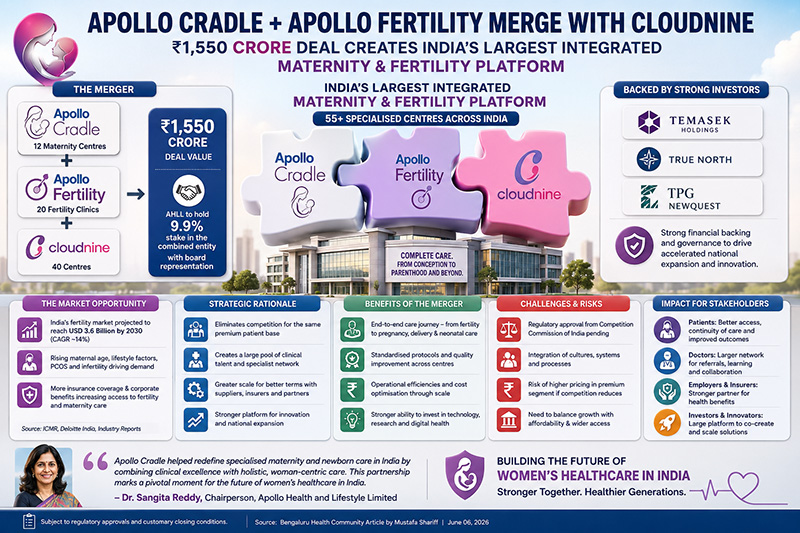
The merger between Apollo Cradle and Apollo Fertility with Cloudnine group marks a historic move in the specialty healthcare sector in India. By acquiring Apollo Cradle and Apollo Fertility for INR 1,550 crore, Cloudnine, which is promoted by Apollo Health and Lifestyle Limited (AHLL), is creating the largest integrated platform solely for women’s healthcare, including maternity, neonatal, and fertility care. This merger is also supported by renowned foreign venture capital funds like Temasek, True North, and TPG NewQuest according to the latest news by Mustafa Shariff, Bengaluru Health Community reporter.
There are many reasons why the merger of Apollo Cradle and Apollo Fertility with Cloudnine is a very wise decision. As per the current trends, the success in healthcare and specialty care, in particular, depends on scale, clinical standards, geographic spread, and patient loyalty. Apollo Cradle has been a well-known maternity hospital chain powered by Apollo ecosystem of medical services, while Cloudnine has been providing high-quality maternity and neonatal care in South India. Furthermore, Apollo Fertility has made strides in the assisted reproductive technologies.
As a result, the acquisition of these brands allows Cloudnine to offer a seamless transition of care from preconception and fertility treatment to childbirth and neonatal care.
From a business perspective, the merger can be viewed as an outcome of global changes in the healthcare market landscape. Nowadays, healthcare systems in the US and Europe are trying to provide patients with comprehensive experience by covering all their needs during the patient journey. As management guru Peter Drucker put it in one of his famous quotes: “The purpose of business is to create and keep a customer”. Similarly, patients’ health journeys might take many years, especially those who require women’s health services. Having a comprehensive fertility-to-maternity healthcare platform is highly beneficial for business.
Fertility and maternity sectors of the Indian healthcare market have seen an increasing number of clients seeking medical help recently. Maternal aging, rising cases of PCOS, urban lifestyle factors, and awareness about fertility treatment methods have caused the rising need for infertility clinics and reproductive care.
At the same time, the increased spending power and changing demands of urban healthcare consumers resulted in a rise in interest for specialized maternity clinics and maternity hospitals that offer luxurious environment to have a baby.
According to ICMR, infertility concerns a considerable part of Indian couple population, and the awareness of infertility is rising among urban citizens of the country. Therefore, a large-scale merger in women’s health segment is likely to bring numerous benefits both for healthcare organizations and consumers of these services.
There are a lot of benefits that Cloudnine merger with Apollo Cradle and Apollo Fertility would generate in addition to the opportunities for scaling up. Larger organization will be able to enhance clinical standards by creating a set of unified protocols, employing more specialists and investing in new technological developments.
Economies of scale can help Cloudnine save money on purchasing medicines, lab supplies, and medical equipment. Moreover, due to larger scale of operations, the merged company is likely to have more clout when negotiating with private healthcare providers.
The merger can also be of interest to the investors who want to work with a large and promising organization in India’s healthcare sector.
However, the merger might bring some risks to the business too. First of all, it can negatively affect competitiveness of other fertility hospitals as a result of lower competitive intensity in the premium market. Also, there is always the threat of becoming less patient-centric while pursuing economic objectives. There are also risks associated with cultural differences between organizations and possible problems related to integration process.
Nevertheless, healthcare mergers have to consider patients’ interests above any others. As one of the most famous physicians Sir William Osler said: “The good physician treats the disease; the great physician treats the patient who has the disease”. The ability to maintain personal approach while scaling operations would be crucial for this merger.
Overall, this merger can be perceived as a logical step towards maturation of women’s health segment of India’s healthcare industry. Similar to cardiology, oncology and orthopaedic markets, women’s health is facing consolidation in order to develop. Subject to regulatory clearance from the Competition Commission of India, the merger can serve as a template for other specialty care consolidations in the future.
Senior Professor and former Head,
Department of ENT-Head & Neck Surgery, Skull Base Surgery, Cochlear Implant Surgery.
Basaveshwara Medical College & Hospital, Chitradurga, Karnataka, India.
My Vision: I don’t want to be a genius. I want to be a person with a bundle of experience.
My Mission: Help others achieve their life’s objectives in my presence or absence!
My Values: Creating value for others.
References:
- Shariff M. Apollo-Cloudnine ₹1,550 Crore Merger: Inside India’s Largest Integrated Maternity and Fertility Platform. Bengaluru Health Community. June 6, 2026.
- Indian Council of Medical Research (ICMR). National Guidelines for Accreditation, Supervision and Regulation of ART Clinics in India.
- World Health Organization. Maternal Health and Safe Motherhood Programs. Geneva: WHO.
- Drucker PF. Management: Tasks, Responsibilities, Practices. New York: Harper & Row; 1973.
- Osler W. Aequanimitas and Other Addresses. Philadelphia: Blakiston; 1904.
- NITI Aayog. Health Systems for a New India: Building Blocks for Potential Growth. Government of India.
- Deloitte India. Future of Healthcare in India: Opportunities in Women’s Health and Fertility Care. Recent industry analyses.





























Leave a reply